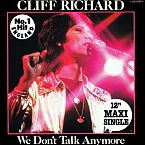
We Don't Talk Anymore

Album: We Don't Talk Anymore (1979)
Charted: 1 7
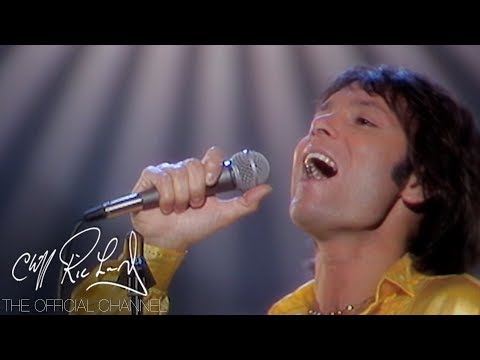
Play Video

Songfacts®:

  • This was written by Alan Tarney, who wrote several other Cliff Richard hits including "My Pretty One" in 1987 and its follow up "Some People."
  • Cliff Richard was born Harry Webb in Lucknow, India of British parents. He joined the Dick Teague Skiffle group in 1957, leaving in 1958 with drummer Terry Smart to form Harry Webb & the Drifters and later in the year he was renamed Cliff Richard. He auditioned for the producer Norrie Paramour (who sadly died while this was at the top of the charts) in August 1958 and signed with EMI, releasing his debut single "Move It," which rose to #2 in the UK charts. His backing group in 1958 featured Hank Marvin, Bruce Welch, Ian Samwell and Terry Smart. The Drifters renamed themselves The Shadows in 1959 to avoid confusion with the US R&B act of the same name. He went on to become Britain's most successful home-grown solo act, with 13 #1s and appearances with Band Aid 2 and The Young Ones on other #1 hits. When "Saviours Day" hit #1 in the UK in 1990 he became the first artist to have #1s in the UK in 5 consecutive decades and he nearly made it six as "Millennium Prayer" was #1 in December 1999. In 1995 he received a knighthood.
  • In the mid-1960s, Richard became a Christian and since then he has recorded a number of inspirational albums. He is arguably the most well known Christian in the British music business and every December he releases a Christmas-themed single, which rarely fails to reach the UK Top 20.
  • Alan Tarney (from 1000 UK #1 Hits by Jon Kutner and Spencer Leigh): '"If you play C,F and G7, you would normally expect to return to C, but I chose to leave it unresolved and go somewhere else. There's a lot of that in We Don't Talk Anymore and it keeps the suspense going. Cliff lost his place at the end, but he is such a brilliant improviser that he kept going. When he sings the bit about losing sleep, he doesn't know where he is."
  • This was Cliff Richard's biggest selling hit worldwide. He was a sensation in Great Britain, but never made a major impact in the United States. This was released when his career in America was at its peak. >>
    Suggestion credit:
    Mike - Santa Barbara, CA
  • The hummed backing vocals on the chorus are by Roxy Music frontman Bryan Ferry - a Cliff fan of old.

Comments: 12

  • Padraig from Nowhere In ParticularIt was the end of the 1970s, and Cliff Richard, verging on 40 after more than 20 years in the business, had a concept, and it was called Rock 'n' Roll Juvenile. It was the time when pop music had gone full circle for the first time, harking back to its 1950s origins with the retro musical Grease and the back-to-the-basics Punk movement as catalysts. It was only consequential then that Richard, a first generation Rock 'n' Roller, decided to go back to his own origins and record his own 1950s-inspired album. Rock 'n' Roll Juvenile was set out to be a tight, coherent affair and return him to the top in a new role as the leader of retro.

    However, harking back to the 1950s was not the only thing that was going on at the time. Technology delivered another aspect to the anyone-can-do-it Punk ideology, as the synthesizer had finally been developed into something basically everyone could use to produce pop music - synth pop music, later called New Wave. One of the emerging synth-pop tunes, We don't talk anymore, was offered to Cliff Richard at exactly the time he was working on Rock 'n' Roll Juvenile, and he accepted, seeing it as a stop-gap single, a quick recording to stay in the public eye before the onslaught of the album.

    Little did he anticipate that We don't talk anymore would turn out to be a smash hit, outperforming everything he had done before (or since) and finally, if temporarily, breaking him into the US. Due to its success, it was even put on the Rock 'n' Roll Juvenile album, a foreshadowing of the 1980s that managed to completely overshadow the otherwise 1950s-retro tunes the album's concept demanded. Turned out that, in this case, a small glimpse of the future was more exciting than a large glimpse of the past.

    We don't talk anymore was, arguably, the last time that Cliff Richard found success as a serious contemporary musician rather than a timeless, not entirely serious icon - his next UK No1 after this would already be the self-deprecating Young Ones version of his old tune Living Doll. The song marked the start of his transformation from artist to his own kind of national treasure. Did he need We don't talk anymore for this transformation? No. But if it had to happen, better it happened with a bang rather than a whimper.
  • Lisa from Fort Worth, TexasCliff has been my favorite singer for decades. What a fantastic song this is, and what an amazing singer and artist. His longevity and success are phenomenal.
  • Keving from Melbourne, Australia There is a bird here in Australia (sorry but I don’t know the type of bird) whose call is the same first four notes of We Don’t Talk Anymore. As Alan Tarney was brought up in Adelaide I’m wondering if he was inspired by this. I would love to hear his thoughts. Fantastic song!
  • Don from Sevierville, TnKen, I have read that the reason Cliff isn't as popular here in the USA as he is in England and Europe is because he doesn't want to be, so he can visit here without being mobbed. He's quite content with his local and continental success in the UK and Europe, along with Australia, some African countries, and I don't know where else.
  • Barry from Sauquoit, NyOn January 13th 1980, "We Don't Talk Anymore" by Cliff Richard peaked at #7 (for 2 weeks) on Billboard's Hot Top 100 chart; it had entered the chart on October 14th, 1979 and spent 20 weeks on the Top 100...
    And on August 25th, 1979 it reached #1 (for 4 weeks) on the United Kingdom's Singles chart...
    In the U.S.A. he has had two other Top 10 hits ("Devil Woman" #6 in 1976 and "Dreaming" #10 in 1980); and in his native U.K. between 1958 and 2008 he had fourteen #1 records and an amazing sixty-nine Top 10 hits...
    Mr. Richard, born Harry Rodger Webb, celebrated his 73rd birthday three months ago on October 14th (2013).
  • Jennifer Harris from Grand Blanc, MiI just love We don't talk anymore and the video. He's almost 70 years old! Wow!
  • Reuben from Amsterdam, NetherlandsThe sound of We Don't Talk Anymore is alike to Dreamin' and Wired for Sound, all produced by Alan Tarny. I wonder what techniques Tarny was using to get this distinctive, flying feeling synth sound. He also produced Barbara Dickson's hit 'January February', which strongly sounds alike to songs by Cliff in that era. My wife and I made love to 'We don't talk anymore' (22 yrs after it was issued) - indeed at that moment we didn't talk a lot.
  • Joann from Portsmouth, VaHappy 69th BIrthday Cliff, (11-14) always loved this song.
  • Mark from Dublin, IrelandWe dont talk anymore,cliffs biggest hit out of over 130 singles released,this was cliffs 75th hit and it reached number one the same year as cliffs long-term producer and father figure norrie paramour passed away,one of the last things cliff said to him was "we're number one, the song itself has gone on to be one of the highlights of cliffs concerts,was written by the man responable for "some people" "dreamin" and dozens of other big hits for cliff. Alan Tarney
  • Ken from Los Angeles, CaCliff Richard is a very talented and successful artist and, sadly, proper recognition has eluded him. This is a great song - to me at least, it feels like a transition from the 70s to the 80s.
  • Jake from Spencer, NyI've got facts here, not comments, but anyway... Here is some chart info. for "We Don't Talk Anymore": In The U.S., it peaked at #7 for 2 weeks (1/19/80 and 1/26/80), and its Top 40 chart progression (14 weeks total, from the week ending 11/17/1979 to the week ending 2/16/1980) is 40-32-20-17-14-13-13-10-9-7-7-13-23-32. It was the
    "greatest mover" within the Top 40 for the w/e Dec. 1, 1979 (32-20). It spent a total of 20 weeks on the entire Billboard Hot 100 (from w/e 10/20/1979 to w/e 3/1/1980). To this date it is Cliff's second-highest charting single in the U.S. (bested only by the classic "Devil Woman," which reached #6 in 1976). In the United Kingdom, "We Don't Talk Anymore" was #1 for 4 weeks from the w/e August 25, 1979, to the w/e September 15, 1979. In Canada, the song spent two weeks at #2 behind Led Zeppelin's "Fool In The Rain" (another great song) during the exact same weeks that it peaked at #7 here in the U.S. (1/19 and 1/26 of 1980).
  • Jake from Spencer, NyCliff Richard's 1979 hit "We Don't Talk Anymore" is a very enjoyable pop tune, with great synthesizers, drums/handclaps, bass line, and key changes, and Cliff's lead and harmony vocals are pleasant as always. All that makes for a really catchy, toe-tapping, and hummable song. Easily one of the best late '70s/early '80s radio-pop type singles.
see more comments

Editor's Picks

Let Me Be Your Teddy Bear: Teddy Bears and Teddy Boys in Songs

Let Me Be Your Teddy Bear: Teddy Bears and Teddy Boys in SongsSong Writing

Elvis, Little Richard and Cheryl Cole have all sung about Teddy Bears, but there is also a terrifying Teddy song from 1932 and a touching trucker Teddy tune from 1976.

Michael Schenker

Michael SchenkerSongwriter Interviews

The Scorpions and UFO guitarist is also a very prolific songwriter - he explains how he writes with his various groups, and why he was so keen to get out of Germany and into England.

Edwin McCain

Edwin McCainSongwriter Interviews

"I'll Be" was what Edwin called his "Hail Mary" song. He says it proves "intention of the songwriter is 180 degrees from potential interpretation by an audience."

Wang Chung Pick The Top Songs Of The '80s

Wang Chung Pick The Top Songs Of The '80sSongwriter Interviews

'80s music ambassadors Wang Chung pick their top tracks of the decade, explaining what makes each one so special.

Stephen Christian of Anberlin

Stephen Christian of AnberlinSongwriter Interviews

The lead singer/lyricist for Anberlin breaks down "Impossible" and covers some tracks from their 2012 album Vital.

Philip Cody

Philip CodySongwriter Interviews

A talented lyricist, Philip helped revive Neil Sedaka's career with the words to "Laughter In The Rain" and "Bad Blood."