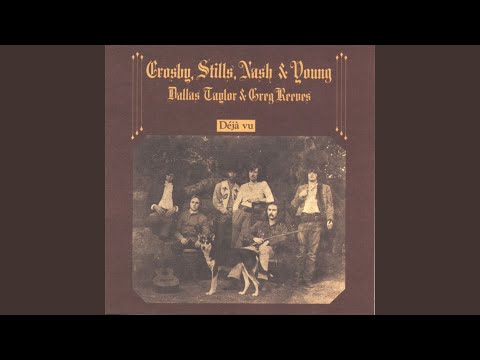

Album: Déjà Vu (1970)
Play Video

Songfacts®:

  • David Crosby wrote this song. He explained in the Guardian July 12, 2008: "I'm one of those people who thinks we go round again. The Buddhists have got it right - it's a wheel and we get on and get off. I think life energy gets recycled. That's why I wrote 'Déjà Vu.'"
  • Crosby wrote in the liner notes of the 1991 box set Crosby, Stills & Nash: "The law of conservation of energy applies: life force just doesn't go away. The identity print gets wiped, mostly, but sometimes there's a ghost print and some stuff hangs around. How else can I explain knowing how to sing harmonies at age six or knowing how to sail a boat the first time I got in one? And having a persistent delusion, all my life, of having been somebody else before."
  • There was a specific case of "Deja Vu" that inspired this song. It happened when Crosby was riding a friend's sailboat. In the 2019 book Crosby, Stills, Nash & Young, he said, "It's as if I had done it before. I knew way more about it than I should have. I knew how to sail a boat right away. Not an instinctive thing. It doesn't make sense. I wasn't thinking about that specifically when I wrote the song. It just came, but in hindsight, the song was informed by those experiences. I felt then and now that I have been here before. I don't believe in God but I think the Buddhists got it right - we do recycle."
  • "Déjà Vu" wasn't released as a single, but was used as the title track the album, the second for Crosby, Stills & Nash and first with Neil Young on board. It was the high point for the band, selling over 7 million copies and inspiring legions of singer-songwriters. By the time it was released in March 1970, the band was already apart, off and working on other projects. They didn't come together again until 1974 for a massive stadium tour (the first in rock history), and didn't issue another album until 1977 (without Young).

Comments: 2

  • Gargatholil from The UniverseDéjà Vu is a very explicit song about karma and reincarnation and the Cosmic Game that we all find ourselves trapped in because of the Law of Karma. We are all caught in repeating cycles of behavior—behavior not only on this plane but on the astral planes, as well. At certain points, as the song’s storyline describes, the consequences of our behaviors come to a head and we are thrust into a karmic crisis. This may involve confronting those to whom we owe some karmic debt. The song references a karmic debt that appears to be the result of our involvement in a mind game in which all of our confronters are also involved. We have all, at some point in our many-life existence, been involved in such games. Payment for the debt is demanded—often through our having to go through some unpleasant happening. We are confused and bewildered, as is the song’s protagonist. We may not clearly remember the circumstances through which this debt originated but we are sure that we would not repeat the same mistake again.
    It is just that, however. We have repeated the same mistake, again and again and again, each time we go around the karmic wheel. As described in the song, the sequence of karmic events leads us right back into the exact same circumstances we had repeated before. Yet we have no clear memory of this—only a feeling that we have been here, done this all before.
    So, we must ask ourselves, what is going on below the ground? What games are being played in our subconscious mind—in the Mind—of which we remain unaware and into which we are trapped? How can we break the karmic Cycle of Birth, Death and Rebirth? This is the universal condition. This is the Devil’s bargain in which we are all caught. This is what we have to figure out.
    For more song interpretations by Gargatholil, buy The Pouring, or How the Universal Mind Reached Out to a Generation, available on Smashwords.com (https://www.smashwords.com/books/view/1158612) and soon (Fall 2002) from Amazon print on demand.
  • Mark B. Stoned from Desperate Hot Springs, CaI recall learning about the conservation of matter and energy in a science class years ago. We learned that matter is constantly recycled and never goes away, but that when energy is recycled, a little bit disappears each time until there is eventually none left. I think Crosby is onto something, though. In stating that everything in the universe is composed of matter and energy, science seems to overlook the possibility of a third component that is not so easily detectable: consciousness. We often speak of the mind, body, and soul; I believe these to merely be individual representations of the universal elements of consciousness, matter, and energy. If both matter and energy are recycled, I would assume that consciousness is also. If that is the case, then I think that would explain the things that Crosby refers to.
see more comments

Editor's Picks

Intentionally Atrocious

Intentionally AtrociousSong Writing

A selection of songs made to be terrible - some clearly achieved that goal.

00s Music Quiz 1

00s Music Quiz 1Music Quiz

Do you know the girl singer on Eminem's "Stan"? If so, this quiz is for you.

Loudon Wainwright III

Loudon Wainwright IIISongwriter Interviews

"Dead Skunk" became a stinker for Loudon when he felt pressure to make another hit - his latest songs deal with mortality, his son Rufus, and picking up poop.

Mick Jones of Foreigner

Mick Jones of ForeignerSongwriter Interviews

Foreigner's songwriter/guitarist tells the stories behind the songs "Juke Box Hero," "I Want To Know What Love Is," and many more.

Brandi Carlile

Brandi CarlileSongwriter Interviews

As a 5-year-old, Brandi was writing lyrics to instrumental versions lullabies. She still puts her heart into her songs, including the one Elton John sings on.

The Real Nick Drake

The Real Nick DrakeSong Writing

The head of Drake's estate shares his insights on the late folk singer's life and music.