Soul Love

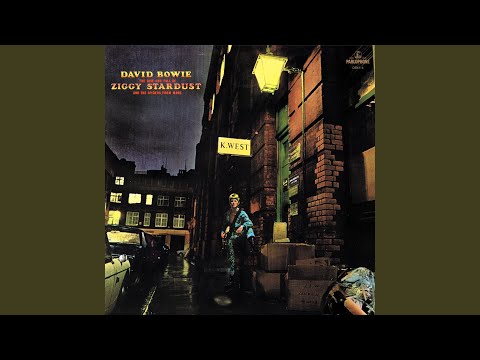
Album: The Rise and Fall of Ziggy Stardust and the Spiders from Mars (1972)
Play Video

Songfacts®:

  • "Soul Love" can be listened to as a song on its own or as part of the Ziggy Stardust mythos.

    On its own, the song is a compassionate yet nihilistic view of the damaging aspects of love and of general human existence. Each verse deals with a different form of love.

    In the beginning there's a mother kneeling at the grave of a son that's been killed in war to "save the slogan," which is a pessimistic take on patriotism and one that harks back to a "Quicksand" (from the Hunky Dory album in 1971) line that mentions the "living proof of Churchill's lies."

    The second verse has two teenagers so madly in love that they believe no other love has existed like it before. They have "new love" and "new words" that are utterly unique to them. Mature people know this story of youthful pretension and know equally that it's doomed for pain and heartbreak.

    The final verse has a priest praying to a God that never answers and only coming away lonelier. This, too, reminds of "Quicksand," calling to mind the line, "Can't take my eyes from the great salvation of bulls--t faith." In both cases, we see Bowie angrily critical of Christianity.

    The three stories may seem disconnected, but taken together they represent the grand sweep of human love. First there's maternal love, the most biologically hardwired of all loves. Second there's romantic and sexual love, driven by biological instincts yet also mixed with some level (depending on the pairing) of consciousness and free will. Finally, there is spiritual love, least biologically driven and most nebulous, a love that relies strongly on psychological abstraction and imagination.

    All three of them, Bowie tells us are, are forms of "idiot love" that wind up wounding us more than they heal. It's a pessimistic view, but Bowie seems driven more than anything by a deep empathy for the doomed position humanity finds itself in.
  • The song doesn't seem to fit into the storyline of the Ziggy Stardust concept album, probably because Bowie wrote it before he ever conceived of Ziggy. The song does fit into the broader narrative, though, just not as obviously as most of the other tracks.

    Both "Soul Love" and "Five Years" (the first two songs on the album) act as preludes to the Ziggy drama. "Five Years" sets things up by letting us know that the world is going to end in five years (and only Ziggy can save us), while "Soul Love" sets the stage by describing this doomed scenario in which humanity finds itself. Even our love is corrupt, and that which is supposed to be our salvation only proves to be the thing that cuts us most deeply. Our biology makes us vulnerable to irrationality while our faith leaves us feeling sad and stranded.

    Once these two songs set the stage, Ziggy enters frame in the third track, "Moonage Daydream."
  • Inspirations have I none
    Just to touch the flaming dove
    All I have is my love of love
    And love is not loving


    The "flaming dove" in the chorus is a biblical reference, possibly specifically to Jesus. Doves appear throughout the Bible as symbols of peace. God uses them as messengers to his people. When Noah is trying to find land after the Flood, he sends out a dove. When the dove doesn't return, he knows that land is near. Matthew 3:16-17 tells us that upon being baptized, Jesus "saw the Spirit of God descending like a dove and coming to rest on him."
  • This song wasn't written with the Ziggy Stardust mythos in mind. It was only after the concept album began to coalesce that Bowie tinkered with it to fit it into the story.
  • On this track Bowie handles lead and backing vocals, 12-string acoustic guitar, baritone saxophone, and handclaps.
  • Bowie recorded "Soul Love" in Trident Studios in London on November 12, 1971.
  • Bowie co-produced the song with Ken Scott, who also produced legends such as Devo, Kansas, and Supertramp. As an engineer, he worked Elton John, Procol Harum, Duran Duran, Pink Floyd, and The Beatles, just to name a few.
  • Nicholas Pegg in The Complete David Bowie notes that the song's sentiments presaged Bowie's 1967-1969 relationship with dancer Hermione Farthingale. Of that relationship Bowie said, "It rotted me, drained me, and it was a disease."

Comments

Be the first to comment...

Editor's Picks

Who's Johnny, And Why Does He Show Up In So Many Songs

Who's Johnny, And Why Does He Show Up In So Many SongsSong Writing

For songwriters, Johnny represents the American man. He has been angry, cool, magic, a rebel and, of course, marching home.

Leslie West of Mountain

Leslie West of MountainSongwriter Interviews

From the cowbell on "Mississippi Queen" to recording with The Who when they got the wrong Felix, stories from one of rock's master craftsmen.

Movie Stars In Music Videos

Movie Stars In Music VideosSong Writing

Johnny Depp, Angelina Jolie, Mila Kunis and John Malkovich are just a few of the film stars who have moonlighted in music videos.

Chris Frantz of Talking Heads

Chris Frantz of Talking HeadsSongwriter Interviews

Talking Heads drummer Chris Frantz on where the term "new wave" originated, the story of "Naive Melody," and why they never recorded another cover song after "Take Me To The River."

Holly Knight ("The Best," "Love Is A Battlefield")

Holly Knight ("The Best," "Love Is A Battlefield")Songwriter Interviews

Holly Knight talks about some of the hit songs she wrote, including "The Warrior," "Never" and "The Best," and explains some songwriting philosophy, including how to think of a bridge.

Jeff Trott

Jeff TrottSongwriter Interviews

Sheryl Crow's longtime songwriting partner/guitarist Jeff Trott reveals the stories behind many of the singer's hits, and what its like to be a producer for Leighton Meester and Max Gomez.