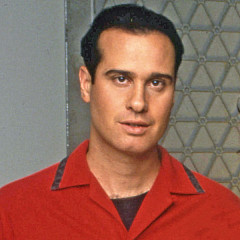
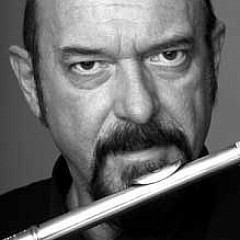
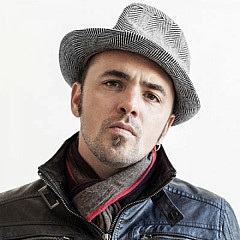
1980-2011Michael StipeVocals
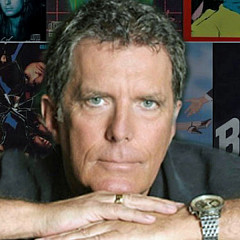
Peter BuckGuitar
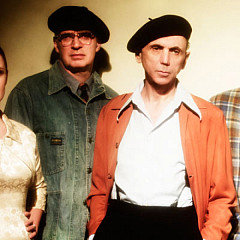
Mike MillsBass
Bill BerryDrums1980-1997
Songwriting credits (and royalties) were shared equally regardless of who wrote the song. This is one reason they stayed around for over 30 years and always seemed to get along - writing credits are often a contentious issue with bands.
Michael Stipe produced the 1999 movie Being John Malkovich. He is often mistaken for Malkovich.
R.E.M. did two MTV "Unplugged" specials. The first was in 1991, the second in 2001.
Stipe used to claim that he could predict earthquakes. He said he got a nasty headache a few days before the 1985 Mexico City earthquake hit.
When the band was asked if R.E.M. stood for Rapid Eye Movement, they replied, "R.E.M. stands for nothing, but will lie down for anything."
Michael Stipe nearly died of scarlet fever when he was 2, of hypothermia when stranded on a mountaintop aged 14, and of a lightning strike at 26.
Mills and Berry were in a lounge act with their high school music teacher. They would dress up and play at weddings and country clubs. But at least they could play. Stipe once explained: "When we started out, Buck couldn't really play the guitar and I couldn't sing. We were like a speed metal band when we started."
Stipe studied painting and photography at the University of Georgia in Athens, Georgia, where the band formed. The band contributed a lot of money and time to keeping Athens beautiful and interesting.
They didn't print lyrics with their albums until 1998 with Up. Michael Stipe explained that fans often have better interpretations than the actual words.
Bill Berry suffered a ruptured cerebral aneurysm during a 1995 R.E.M. concert in Switzerland. He recovered and played on the 1996 album New Adventures in Hi-Fi, but left the group in 1997 to pursue farming. He later made occasional live appearances with R.E.M.
Stipe's sister, Linda, was in a band called Oh-OK with Matthew Sweet around the same time R.E.M. was forming.
Michael Stipe has discussed his sexuality from time to time, but prefers not to. In a 2001 Time magazine story, he said he had been in a relationship with a man for the last three years. Ten years later, he told The Observer, "I definitely prefer men to women."
Stipe and Natalie Merchant were a romantic couple in the late '80s when Natalie was lead singer of 10,000 Maniacs.
They originally called themselves the Twisted Kites before deciding on the name R.E.M. while flipping through a dictionary.
They were named "Best Band in America" by Rolling Stone magazine in 1987.
Michael Stipe refused to lip-synch in most of their '80s videos because he thought lip-synching was "stupid." Instead, they made lots of very artsy, conceptual videos that got bigger budgets as the band got more successful. Stipe lifted his lip-synch ban for "
Losing My Religion" in 1991.
In his spare time, Michael Stipe enjoys making replicas of everyday objects that interest him using bronze or birch plywood. His sculptures include a Polaroid camera, a microcassette and a newspaper.
On September 21, 2011, R.E.M. issued a statement on their website, declaring that they were "calling it a day as a band." Asked by Rolling Stone how the breakup came about, Peter Buck recalled:
"We were doing the last record, [2011's] Collapse Into Now. We hadn't made an announcement or anything. We got together, and Michael said, 'I think you guys will understand. I need to be away from this for a long time.' And I said, 'How about forever?' Michael looked at Mike, and Mike said, 'Sounds right to me.' That's how it was decided."
Peter Buck played the same black Rickenbacker guitar on every R.E.M record. He told Mojo in 2017: "That's the only physical thing of ownership that I would miss if it was gone. It got stolen on the last R.E.M tour and we had to ransom it back. I really didn't like the idea of some creep-thief holding it."
R.E.M. played their first concert together as band at a friend's birthday party on April 5, 1980. The venue was an abandoned Athens, Georgia, church. Mills recalled on the PBS show Speakeasy, that the band's first show "was crazy," while noting, "Athens was a very tight, insular sort of crowd at that point, and everybody there knew each other."