The Lord's Prayer

Album: With You I Am (1974)
Charted: 4
Play Video

Songfacts®:

  • In 1974, a Roman Catholic nun in Australia had a Top 10 multinational hit with a disco-pop song in which she sings the Lord's Prayer. Now that we have your attention, let's repeat that so you're sure you read it right: In 1974, a Roman Catholic nun in Australia had a Top 10 multinational hit with a disco-pop song in which she sings the Lord's Prayer. It's the kind of song story that makes us love our job here at Songfacts.

    Oh, and she's not the first nun on the Billboard chart; that honor goes to Sister Luc-Gabrielle, 1963, who hit #1 on the Hot 100 with "Dominique."

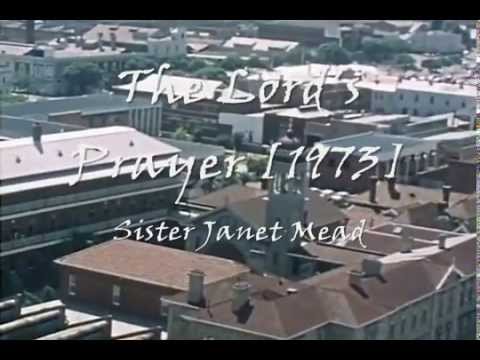
    Sister Janet Mead intertwined a music career with her church work, forming a rock band which performed a series of "rock masses" that she conducted at Adelaide Cathedral. She went pro about 1973, going to Sydney to record on a Festival Records contract. "The Lord's Prayer" was the idea of her producer, Martin Erdman. The single became the first Australian recording to sell over one million copies in the US. (Suck it, AC/DC!)
  • Sister Janet went on to fame, fortune (all donated to charity, of course), and awards (including a Yamaha Golden Gospel Award and a Grammy nomination). However, she was a nun, after all, and was quite media-shy and conflicted about her success. In interviews, she later described her fifteen minutes as "a horrible time." Only in the 2000s did she return to her love of music, but trying to do so in a more low-key fashion.
  • Bible-study section: Scriptural scholars will note the irony of the success of this song. You see, the Lord's Prayer, in the King James Bible, occurs at Matthew 6, verse 9-13. If you read through the entire chapter, Jesus was offering this as an example of how to pray, in the middle of a lecture about how one should not be public, open, and prideful in their worship, but to keep it between yourself and God. In this lecture, Jesus scorns those who wear their reverence on their sleeve, seeking the favor of the public: "Do not sound a trumpet before thee, as the hypocrites do in the synagogues and the streets," "Thou shalt not be as the hypocrites are; for they love to pray standing in the synagogues and in the corners of the streets, that they may be seen of men," and even "when ye fast, be not, as the hypocrites, of a sad countenance: for they disfigure their faces, that they may appear unto men to fast." And so on. So then, the example prayer becomes a hit Billboard single and wins awards and is heard all around the world.

Comments

Be the first to comment...

Editor's Picks

Howard Jones

Howard JonesSongwriter Interviews

Howard explains his positive songwriting method and how uplifting songs can carry a deeper message.

Susanna Hoffs - "Eternal Flame"

Susanna Hoffs - "Eternal Flame"They're Playing My Song

The Prince-penned "Manic Monday" was the first song The Bangles heard coming from a car radio, but "Eternal Flame" is closest to Susanna's heart, perhaps because she sang it in "various states of undress."

Brandi Carlile

Brandi CarlileSongwriter Interviews

As a 5-year-old, Brandi was writing lyrics to instrumental versions lullabies. She still puts her heart into her songs, including the one Elton John sings on.

Meshell Ndegeocello

Meshell NdegeocelloSongwriter Interviews

Meshell Ndegeocello talks about recording "Wild Night" with John Mellencamp, and explains why she shied away from the spotlight.

Dave Alvin - "4th Of July"

Dave Alvin - "4th Of July"They're Playing My Song

When Dave recorded the first version of the song with his group the Blasters, producer Nick Lowe gave him some life-changing advice.

Bass Player Scott Edwards

Bass Player Scott EdwardsSong Writing

Scott was Stevie Wonder's bass player before becoming a top session player. Hits he played on include "I Will Survive," "Being With You" and "Sara Smile."