Paul McCartney wrote this one. His friend Alistair Taylor, who was visiting, asked Paul one day how he wrote his many songs and how he came up with ideas. Paul took him into his dining room to give him a demonstration on his hand-carved harmonium. As an experiment, Paul asked Taylor to shout out the opposite of whatever he sang, such as black and white, yes and no, hello and goodbye, etc. From this, the song was born.
John Lennon hated the song. He viewed it as an inconsequential song of McCartney's, saying it was "three minutes of contradictions and meaningless juxtapositions." What further infuriated Lennon was that his "I Am The Walrus," was issued as the B-side to McCartney's A-side "Hello Goodbye."
This is one of those songs that is either trite nonsense or deeply meaningful depending on your mindset. The deeply meaningful interpretation is that the song speaks to how people are always different in what they say and do.
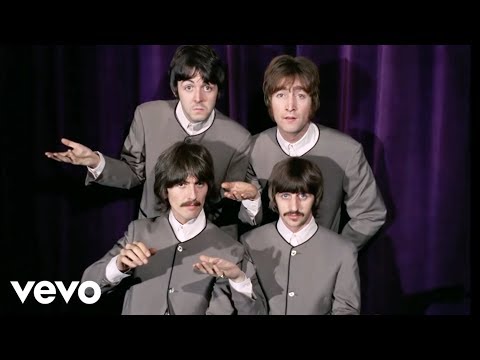
The Beatles made a music video for this, but at the time they were called promotional films. It was banned by the BBC because Paul was clearly lip-synching, which was against The British Musician's Union's rules.
Shortly after this was released, McCartney explained, "The answer to everything is simple. It's a song about everything and nothing. If you have black you have to have white. That's the amazing thing about life."
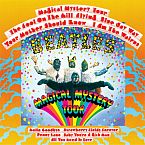
The ending where all The Beatles sing, "Hela, hey, aloha," was improvised in the studio. This part plays over the end credits of the
Magical Mystery Tour movie.
>>>
Suggestion credit:
Bertrand - Paris, France, for above 2
The working title was "Hello, hello."
There is a fake ending on this song that drove disk jockeys nuts, as the sound of dead air made them think the song had ended before they were ready.
Target used this in commercials with the lyrics changed to "Hello, Good Buy." The Beatles do not control the publishing rights for most of their songs and cannot keep them from being re-recorded and used in ads.
In 2008, Jonas Brothers recorded the song for a new Target commercial.
When Paul McCartney played a show in Tel Aviv, Israel on September 25, 2008, he opened with this song. It was the first time a Beatle performed in the country. Ofer Lichtman, who covered the show for The Times of Malta, wrote: "There is still a debate regarding the true reason behind declining The Beatles' arrival to perform in Israel. The common story behind it was simply the lack of money and the prudence of the Israeli government. Due to Israel's poor economical situation in the '60s the organizers and promoters could not come up with the sufficient funds that were claimed and when they appealed to the Israeli Government for help, they were turned down because "The Beatles were a threat on the morality of the youth.
Forty-three years later, earlier this year, the Israeli Government has sent its ambassador in Britain to officially apologize to Paul McCartney, Ringo Starr and to the relatives of John Lennon and George Harrison for its unfortunate decision. After weeks of nerve racking anticipations and contradicting headlines, Paul jumped on the stage in Tel Aviv in front of an audience of 50,000 people and gave us an outstanding night to remember and a story to tell our children and grandchildren. After all those years Paul has decided to come and play in Israel in spite the many life threats he got from extreme Islamic groups."
In 2009 The Performing Rights Society announced this as the most ever played Beatles song in public places in the UK. One of the reasons for this is that this was the first Beatles single release after BBC Radio 1 started broadcasting and the station played this song endlessly.
The California power pop band Hellogoodbye took their name from this song.
On the final episode of
The Late Show with Stephen Colbert (May 21, 2026), Paul McCartney was a surprise guest and
ended the show with a rendition of "Hello, Goodbye" joined by Colbert, Elvis Costello and Jon Batiste. As the song vamped out ("hela, heba, helloa..."), staffers came on stage to join in the fun.
The show was recorded in the Ed Sullivan Theater, where The Beatles
famously appeared on the
Ed Sullivan Show in 1964 to kickstart Beatlemania. As "Hello, Goodbye" faded out, the show ended with McCartney turning out the lights, bringing it full-circle.