
The Beatles are considered the most commercially successful band, not only in the 1960’s, but of all time. In 1966, Revolver was the bridge between Rubber Soul and Sgt. Pepper’s Lonely Hearts Club Band. A giant step in the development of The Beatles’ sound. The album signaled a shift in the direction of pop music, leaning heavily into psychedelia for the rest of the decade. In some ways, Revolver felt like an experiment that set a new precedent entirely. Here are 4 wild tricks The Beatles used in the studio, innovating pop and rock music forever.
The Use of Tape Loops
Initially, Paul McCartney’s idea, The Beatles used tape loops on tracks such as “Tomorrow Never Knows.” Paul was inspired by avant-garde artists of the time. Each member of The Beatles prepared loops at home and brought them into the studio. Tediously, this was done by cutting a section of reel-to-reel tape and splicing the ends together. The use of tape loops became popular throughout the rest of the decade. The heavy use of tape loops for “Tomorrow Never Knows” meant the reels extended out of the control room and down the hallway of the studio.
John Lennon Sang Through a Leslie Speaker Cabinet
A truly innovative concept at the time was the idea of the Beatles’ sound engineer, Geoff Emerick. On the track “Tomorrow Never Knows,” John Lennon sang through a mic that was wired to a revolving speaker. Simultaneously, Ringo Starr played the drums. The revolving speaker was inside a Leslie cabinet, designed to be used for a Hammond organ. The group and recording team were pleased with the result. Initially, Lennon considered swinging upside down to achieve a similar effect. Luckily, he never had to resort to that.
George Harrison’s Backwards Guitar Solo
With the use of modern recording technology, we can easily play tracks backwards. In 1966, this hadn’t been done before. For the track “I’m Only Sleeping,” Harrison mapped out a solo that would work well played backwards, giving a dreamy effect. Just like the previously mentioned tape loops, this was achieved by physically cutting and taping the reel-to-reel. Nowadays, guitarists use a reverse delay pedal to emulate this effect.
Automatic Double Tracking
On April 6, 1966, EMI technical engineer Ken Townsend invented the use of “Automatic Double Tracking.” This technique became a signature sound for The Beatles. Originally, The Beatles would sing the same part twice for a double track, which can be heard on many of The Beatles’ early recordings. Eliminating the need for recording the same vocal part twice, this technique uses delayed tape-based signals to double the vocals automatically. Ultimately, this saved studio time and added to the psychedelic effect on songs like “Tomorrow Never Knows.”
More Lists
-
Photo by Stuart Westwood/SOPA Images/LightRocket via Getty Images -
British actor and singer Tim Curry performing live, Canada, 1979. (Photo by Peter Noble/Redferns) -
Photo by Daniel Knighton/Getty Images -
Photo by Myrna Suarez/Getty Images -
Photo by Victor Fraile/Getty Images -
Photo by Terry Wyatt/Getty Images for Spotify -
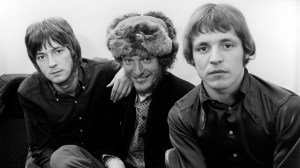
From left, Eric Clapton, Ginger Baker (1939-2019) and Jack Bruce (1943-2014) of British rock group Cream posed in their dressing room at Associated Rediffusion's Wembley Television Studios in north west London on 4th November 1966. Cream are booked to perform the songs 'Wrapping Paper' and 'N.S.U' on the music television show Ready Steady Go! at the studios. (Photo by Ivan Keeman/Redferns) -
Photo by Jeff Kravitz/FilmMagic