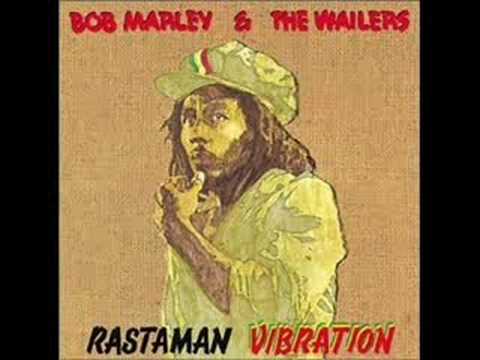
Album: Rastaman Vibration (1976)
Play Video

Songfacts®:

  • The lyrics of "War" come from a speech given by Haile Selassie I on October 4, 1963, when he addressed the United Nations. Selassie, also known as Ras Tafari and considered to be God, or Jah, in Rastafarianism, was advocating for peace and calling for unity in the face of discrimination. In the speech, he set forth a number of conditions necessary before peace can come to Africa. Among those that made the lyric:

    "The philosophy which holds one race superior and another inferior is finally and permanently discredited and abandoned."

    "There are no longer first class and second class citizens of any nation."

    "The color of a man's skin is of no more significance than the color of his eyes."
  • Bob Marley punctuated the statements from Haile Selassie's speech with the line, "Me say war," indicating he's willing to fight for these beliefs. He ends it on a positive note, taking more from the speech:

    "We know that we shall win, as we are confident in the victory of good over evil."
  • This song is part of the Bob Marley & the Wailers album Rastaman Vibration, their first to get much attention in America. Marley spent a few months touring the country to support it and quickly built a following there. After his death in 1981, Marley became more popular than ever. His 1984 compilation album Legend sold over 15 million copies in the US.
  • The songwriting credits are listed as Allen Cole and Carlton Barrett, which is misleading. Marley kept his own name off the credits because of a dispute with his publisher and listed various family and friends instead. Cole was a Jamaican soccer star and Barrett was Marley's drummer.
  • Sinead O'Connor was drawn to this song after learning about how Jamaicans were historically oppressed by the British. Like many Irish citizens, she believed her country had also suffered under British rule.

    The song came into her consciousness after her song "Nothing Compares 2 U" (written by Prince) launched her to stardom in 1990. She never wanted to be famous, so when she was, she saw how it created divisions. She decided to become a protest singer instead of a pop star, and "War" was her vessel.

    O'Connor sang "War" - a cappella - at two landmark events in music history. On October 3, 1992, she performed it on Saturday Night Live, ending by tearing up a photo of the Pope and saying, "Fight the real enemy."

    On October 16, 1992, she sang it at a Bob Dylan tribute concert in Madison Square Garden. She was supposed to sing Dylan's "I Believe In You," but many in the crowd were hostile, so she froze. After Kris Kristofferson came on stage to encourage her, she went off script and shouted out "War."

    These appearances helped establish O'Connor as very anti-establishment and perhaps a little nuts. She later needed extensive treatment for her mental health issues, but was also vindicated in many ways as history showed she was making valid points. Her studio version of the song can be found on the 2005 album Throw Down Your Arms.

Comments: 2

  • Bruno from Lima, PeruThe first known version of this song by Sinead O'Connor was the A capella version that she performed on Saturday Night Live. She changed the mentions of the African countries in the song by the repetition of the phrase "child abuse" as a protest for the child abuse by Catholic priests and the tolerance of that by the Vatican. It was because of this that she tore up the photo of the Pope John Paul II.
    The second known version was performed in the Bob Dylan's 30th Anniversary Concert Celebration when the audience booed at her about the SNL events two weeks before. This version was a capella too, in a more wilder style. At the end of her terrific performance she let the stage and cried in the arms of Kris Kristofferson.
    The third and only official release version was that can be found in her reggae album "Thrown down your arms" in a reggae style and without changes in the lyrics.
  • Adam from South Pasadena, IsraelOne of his most powerful songs
see more comments

Editor's Picks

Little Richard

Little RichardFact or Fiction

Was Long Tall Sally a cross-dresser? Did he really set his piano on fire? See if you know the real stories about one of rock's greatest innovators.

Michael Glabicki of Rusted Root

Michael Glabicki of Rusted RootSongwriter Interviews

Michael tells the story of "Send Me On My Way," and explains why some of the words in the song don't have a literal meaning.

Greg Lake of Emerson, Lake & Palmer

Greg Lake of Emerson, Lake & PalmerSongwriter Interviews

Greg talks about writing songs of "universal truth" for King Crimson and ELP, and tells us about his most memorable stage moment (it involves fireworks).

Charlie Daniels

Charlie DanielsSongwriter Interviews

Charlie discusses the songs that made him a Southern Rock icon, and settles the Devil vs. Johnny argument once and for all.

Desmond Child

Desmond ChildSongwriter Interviews

One of the most successful songwriters in the business, Desmond co-wrote "Livin' La Vida Loca," "Dude (Looks Like A Lady)" and "Livin' On A Prayer."

Timothy B. Schmit

Timothy B. SchmitSongwriter Interviews

The longtime Eagle talks about soaring back to his solo career, and what he learned about songwriting in the group.