This song is about a scientist who is so caught up in his work that he neglects his girlfriend. When he gets his priorities straight, he wants to "go back to the start" and begin fresh.
Chris Martin said this song is based on his "disasters with girls." In a track-by-track reveal, he explained the development of the song: "That's just about girls. It's weird that whatever else is on your mind, whether it's the downfall of global economics or terrible environmental troubles, the thing that always gets you most is when you fancy someone."
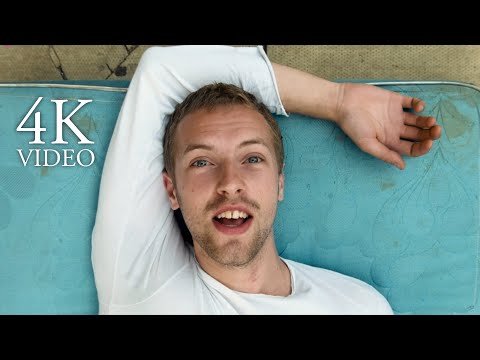
The Grammy-nominated music video, directed by Jamie Thraves ("
Just" by Radiohead, "
I Will Follow You into the Dark" by Death Cab for Cutie), is rather inventive, with all the action going backwards, apropos for a song about going "back to the start." It starts with Chris Martin lying on a mattress and plays in reverse as we see how he got there. We learn that he was driving on a country road with his girlfriend in the passenger's seat when he swerved to avoid another vehicle, sending their car careening down a hill. His girlfriend is tossed through the windshield and presumably dead, but Martin wakes up and wanders off, eventually ending up on the mattress.
The video was shot with the action moving forward, then reversed in post production. A key component is the lip-synch - making sure Chris Martin is singing normally in the finished product. To achieve this, he had to sing backwards so when the video was reversed, he'd appear to sing normally. This meant learning the song backwards, which took him weeks.
Spike Jonze directed a backward video for the 1996 Pharcyde song "Drop," but that one bent time and space by having the group move backward in sections. In the Coldplay video, everyone moves in the same direction.
Some of the video for "The Scientist" was shot at Bourne Wood in Surrey, which famously served as the backdrop for the opening battle scenes of the 2000 historical drama Gladiator, starring Russell Crowe. Parts of Band of Brothers, Children of Men, and Thor were also filmed in the same woodland.
Chris Martin (from Rolling Stone July 14, 2005): "On the second album I was thinking there was something missing. I was in this really dark room in Liverpool, and there was a piano so old and out of tune. I really wanted to try and work out the George Harrison song 'Isn't It A Pity,' but I couldn't. Then this song came out at once. I said, 'Can you turn on the recorder?' The first time I sung it is what's out there."
Martin has stated the guitar section at the end of this song is his favorite bit of music on A Rush of Blood to the Head. Coldplay guitarist Jonny Buckland came up with the surging, powerful riff three weeks after Martin originally wrote "The Scientist."
Coldplay performed the song at the 2003 Video Music Awards, where they won for Best Group Video, Breakthrough Video and Best Direction. They were introduced by Justin Timberlake, a close friend of lead singer Chris Martin who credits Coldplay as "the best band in the world."
>>>
Suggestion credit:
Britney - Calabasas, CA
After listening to the song in reverse over and over again for the video, Chris Martin realized how beautiful the end of the song was when played backwards. He thought it sounded so wonderful that during Coldplay's Twisted Logic tour, right after they played the song, a reverse sound clip of the end of the song would be played while the band set up for their next song.
>>>
Suggestion credit:
Corey - North Wales
In 2011, country legend Willie Nelson covered "The Scientist" for Chipotle's short film Back to the Start, about the importance of developing ethical farming practices. Nelson's cover went on to close his 2012 album Heroes, as well as play during the end credits of the 2014 legal drama The Judge.
Corinne Bailey Rae covered this song for the second installment of the Fifty Shades film franchise, Fifty Shades Darker, in 2017. Fun fact: The movie's lead actress, Dakota Johnson, would go on to have a long-term relationship with Martin.
This song was featured in the 2003 movie
Wicker Park. It's played at the very end when the main character, played by Josh Hartnett, is going through an airport and finds his true love he hasn't seen in years.
>>>
Suggestion credit:
Brittany - Richmond, KY
The word "Scientist" does not appear in the lyrics, though "science" crops up several times. The liner notes from A Rush of Blood to the Head state: "The Scientist is Dan." Dan being Dan Keeling, the A&R man who signed the band to Parlophone.
"The Scientist" was released in the US on April 15, 2003, as the third single from Coldplay's sophomore studio album,
A Rush of Blood to the Head. It was originally supposed to be released as the second single from the album, but Coldplay's record label feared it wasn't upbeat enough for radio listeners and instead chose "
Clocks." Following its release, "The Scientist" peaked at #5 on the Billboard US Adult Alternative Airplay chart.
The song made its first appearance on the Hot 100 in October 2012 when a cover by the Glee Cast peaked at #91. The cover was originally performed in the episode "The Break Up" of the popular musical television series.
The Irish actress Elaine Cassidy portrays the female passenger in the video. She is best known for playing the lead character Abby Mills in the American CBS TV series Harper's Island and Katherine Glendenning in the BBC TV series The Paradise. Cassidy recalled the filming of the clip to The Mail On Sunday's You Magazine: "At a party I met a director who asked if I wanted to be in a pop video. The film clip was recorded in reverse, Twin Peaks-style, so Chris Martin had to learn the song backwards – I know it backwards now, too. We were supposed to kiss in the original script, but Chris refused – he'd just got together with Gwyneth Paltrow. So I was snubbed by Chris Martin!"
Speaking to VH1 soon after the release of A Rush of Blood to the Head, Martin expressed his concern that Coldplay had peaked with "The Scientist": "I don't think we'll ever top it, which is why we probably won't do another record!"
When Chris Martin first played the ballad to the rest of the band, they immediately saw it was something special. "Chris says, 'I've got this song to play to you,'" bassist Guy Berryman remembered to
Zane Lowe on Apple Music Hits. "Just on the little upright piano, he just played and sang the whole song from beginning to end, and it was kind of finished.
We were like, 'Oh wow, OK. That's really great.' I think we all felt a bit nervous because we were like, 'Wow, this is so great. How can we add instrumentation to this?' So, it's just basically not to ruin it and ruin that feeling that we'd all just had from listening to that amazing song."
Martin's bandmates then worked on their respective parts and almost completed the track that same night. "I always feel like those kinds of songs, when you don't have to over engineer it or overthink it or try three or four different versions before you feel it's right," Berryman added, "you can fall in love with it or get it immediately and record it within a few hours."
"The Scientist" has remained a staple of Coldplay's live shows. Drummer Will Champion said after hearing it for the first time, he knew it would be a song that they'd "play forever."