Town Without Pity

Album: Jukebox Hits of 1961 (1961)
Charted: 32 13
Play Video

Songfacts®:

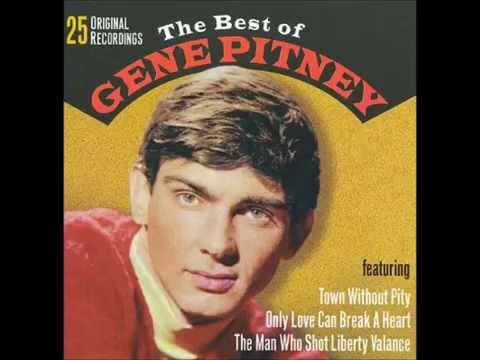
  • "Town Without Pity" was Gene Pitney's first hit. Its success was partly due to it being from the movie of the same name, with the star appeal of Kirk Douglas attracting a lot of attention. The song won the very first Golden Globe award for best original song, and was nominated for an Academy Award for Best Song. This led to Pitney becoming the first pop singer to perform at the Oscars in 1962.
    Ironically, this song also capped Gene Pitney's career and life - it was the final song he performed at his final show at Cardiff's St. David's Hall in April of 2006, before his death from heart disease.
  • Today's movie buffs might better remember this song from the memorable scene in the film Look Who's Talking, when Kirstie Alley performed a rather vampy dance to it (playing on the radio) while getting the kid his pudding. She even sings along briefly!
  • Al Kooper reminisces his first encounter with Pitney in his book, Backstage Passes and Backstabbing Bastards: "...this guy walks in wearing a salt and pepper jacket, heavily greased-down DA ("duck's ass") hairdo, and white bucks. Three dressing schools tied together; very strange. The creature was quickly ushered in, sat down at the piano, and proceeded to mesmerize us for two uninterrupted hours with his incredible songs and bizarre voice." Kooper heartily recommended signing him when producer Aaron Schroeder asked for his opinion.

    Blood, Sweat & Tears front-man Al Kooper goes on to say of Pitney that he was strongly influenced by him, assimilating aspects of his style into his own work. Randy Newman's song "Just One Smile," included on the first Blood, Sweat & Tears album, was originally done by Pitney; Kooper cites this as an example of the longevity of Pitney's inspiration.

Comments: 5

  • John Lynch from Winter Haven, FloridaWhen I was a boy, they didn't have Wheel of Fortune and Jeopardy between the evening news and prime time, the time went to locally programmed syndication, things like Mantovani, The Contemporaries or Fractured Flickers and I very clearly remember seeing content involving Gene Pitney on Italian television. Although I don't believe Gene Pitney had Italian ancestry, he was practically Honorary Italian and did an all Italian language album that included "Town Without Pity" as "La città spietata" and he was very much from Connecticut, a state that may have the highest percentage of Italian-Americans in the United States. The song always had a sort of Sanremo Music Festival of Italian song feel to me. That's where Dusty Springfield heard Pino Donaggio singing the song she had English words written for and re-recorded as "You Don't Have to Say You Love Me"

    Gene was pretty popular in Italy and Sanremo was a bit of a precursor to Univision only all Italian songs with many done by international stars like Pitney.

    I might also note that the drummer on "Town Without Pity" is Gary Chester, sort of like the Hal Blaine of the East Coast. He was born "Cesario Gurciullo"

    Pitney was very gifted and tqlented but perhaps part of a dying breed, even though he had some connections to Phil Spector and the early Rolling Stones.

    Although Joe South and Billy Joe Royal were from Georgia, early Billy Joe Royal via Joe South was a bit like a Gene Pitney substitute and their song "I Knew You When", later covered by many including Linda Ronstadt, had a good bit of that Italian emotional feel to it. Joe's song had first been recorded by Wade Flemons but did not take off as much as Billy Joe Royal's hit version.
  • Barry from Sauquoit, NyOn February 4th 1962, Gene Pitney appeared on the BBC-TV variety TV program 'Thank Your Lucky Star'*...
    At the time he didn't have a record on the United Kingdom's Top 40 chart; but five weeks later on March 24th his "Town Without Pity" would debut on the chart at #34, and that would also be it peak position of the Top 40...
    While across the pond in the U.S.A. the song was at #17 on Billboard's Hot Top 100 chart; two weeks earlier it had peak at #13...
    {See next post below}...
    * Right after his appearance on 'Thank Tour Lucky Stars' show he started his first tour of the United Kingdom.
  • Barry from Sauquoit, NyOn January 16th 1962, Gene Pitney performed "A Town Without Pity" on the ABC-TV program 'American Bandstand'...
    Three months earlier on October 24th, 1961 it entered Billboard's Hot Top 100 chart; and on January 21st, 1962 it peaked #13 (for 2 weeks) and spent 19 weeks on the Top 100...
    It reached #10 in Canada...
    His next charted record was also from a movie, the John Wayne film "The Man Who Shot Liberty Valance", it peaked at #4 and stayed on the Top 100 for 13 weeks...
    Note: In 1961 a jokester DJ on our local AM radio station is Utica, NY would always introduce the record as "A Town Without Pitney" by Gene Pity...
    R.I.P. Mr. Pitney (1940 - 2006).
  • Dan from Winthrop, MaAlso covered as an instrumental by the late Ronnie Montrose.
  • Barry from Sauquoit, Ny"Town Without Pity" was nominated for Best Song at the 1961 Oscars {Lost out to "Moon River"}
see more comments

Editor's Picks

John Lee Hooker

John Lee HookerSongwriter Interviews

Into the vaults for Bruce Pollock's 1984 conversation with the esteemed bluesman. Hooker talks about transforming a Tony Bennett classic and why you don't have to be sad and lonely to write the blues.

Angelo Moore of Fishbone

Angelo Moore of FishboneSongwriter Interviews

Fishbone has always enjoyed much more acclaim than popularity - Angelo might know why.

Millie Jackson

Millie JacksonSongwriter Interviews

Outrageously gifted and just plain outrageous, Millie is an R&B and Rap innovator.

Director Mark Pellington ("Jeremy," "Best Of You")

Director Mark Pellington ("Jeremy," "Best Of You")Song Writing

Director Mark Pellington on Pearl Jam's "Jeremy," and music videos he made for U2, Jon Bon Jovi and Imagine Dragons.

Who's Johnny, And Why Does He Show Up In So Many Songs

Who's Johnny, And Why Does He Show Up In So Many SongsSong Writing

For songwriters, Johnny represents the American man. He has been angry, cool, magic, a rebel and, of course, marching home.

Lita Ford

Lita FordSongwriter Interviews

Lita talks about how they wrote songs in The Runaways, and how she feels about her biggest hit being written by somebody else.