The phrase "hit the wall" comes from endurance sports, particularly marathon running, where it describes the moment the body runs out of readily available energy and everything suddenly feels much, much harder. It represents a biological ambush, the point where continuing requires sheer willpower.
For Gracie Abrams, her song "Hit the Wall" repurposes that idea as emotional burnout. More specifically, her own self-destructive tendencies and how they get in the way of love, even when she desperately wants it to work.
Hit the wall, I just hit the wall
I'm not a problem you can solve
Abrams has reached a point of emotional paralysis, a moment where she recognizes she has run out of road, and that what she is dealing with goes beyond what love alone can fix.
Abrams explained on The Morning Show with Elvis Duran that "Hit The Wall" is about emotional exhaustion and self-destructive patterns. "The song isn't as much about a relationship as it is sort of about a certain degree of fatigue and white knuckling in general, which I think we're all sort of doing to get through these times," she said. "I think this song was a relief to write because it was, for me, about naming a lot of feelings that I had not wanted to look at very closely."
Abrams expanded on the idea in an interview with SiriusXM, describing the song as inspired by the importance of finally confronting internal struggles instead of ignoring them: "Sometimes we try to ignore the alarms ringing in our heads, and it just gets louder and louder."
Themes of anxiety and OCD have appeared throughout Abrams' music; "Hit the Wall" is one of her most direct explorations of them. It echoes earlier songs like "
Difficult," where she examined self-esteem and emotional instability with similar candor.
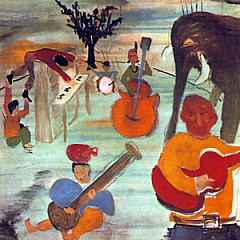
Abrams nods in the third verse to Joni Mitchell's 1971
Blue track "
A Case Of You."
"A Case of You" playing in the hallway, hallucinations that I downplayAbrams draws a parallel between Mitchell's song's portrait of an intense, lingering relationship and her own uncertainty about whether things were ever stable to begin with. The connection extends visually: Abrams said the music video's aesthetic is an homage to Mitchell's
Blue album.
"Hit the Wall" was written and produced by Abrams alongside Aaron Dessner, her frequent collaborator. Dessner noted that the song emerged during a moment when the two were "hitting a wall" creatively, which fed directly into the track's theme.
Bon Iver's Justin Vernon contributed background vocals and synthesizer. His working relationship with Dessner dates back to their long-running collaborative project Big Red Machine, which began in the late 2000s.
The recording features a full string section of 21 players - violins, violas, cellos, and double bass - conducted by Macedonian violinist, conductor, and music professor Oleg Kondratenko.
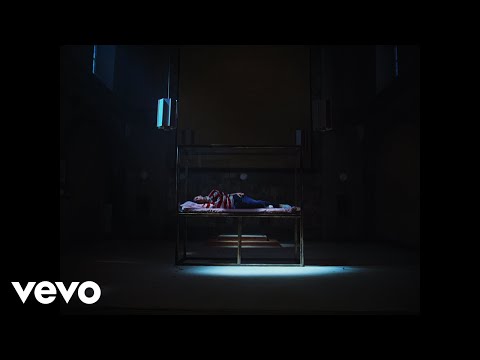
The video places Abrams in a series of surreal, shifting environments connected by blue doors, a visual motif referencing Joni Mitchell's Blue. Scenes include a hospital setting with inkblot tests and a long, unsettling corridor with twin figures, echoing imagery from The Shining. The visual concludes on a bittersweet note with Abrams singing in front of a burning tree, delivering the line, "I'm not a problem you can solve."
Dominican-American photographer Renell Medrano directed the video. Her resumé also includes the clips for "
Hammer" by Lorde, "
Nuevayol" by Bad Bunny, and "
Good Flirts" by Baby Keem.
"Hit the Wall" is the opening track and lead single from Abrams' third album,
Daughter from Hell, following her 2024 release
The Secret of Us. Like its predecessor, the album was created in close collaboration with Dessner, with recording sessions beginning on the same day they laid down
The Secret Of Us (Deluxe) tracks "
That's So True" and "I Told You Things" at Electric Lady Studios in New York. Abrams described "Hit The Wall" as a deeply honest reflection of where she was mentally while creating
Daughter From Hell.
Speaking on CBS Sunday Morning, Gracie Abrams recalled walking to the studio from New York's Chelsea neighborhood feeling emotionally drained. She was missing a friend and found herself on what she described as "one of those New York emotional teary walks."
When she arrived at the studio, Aaron Dessner was already working on a piece of music she'd never heard before. "I remember coming to the studio that day generally feeling a bit sore," Abrams said. "I walked upstairs and I heard the intro to 'Hit the Wall' playing. It was one of those cosmic things where the sound that I heard was exactly paired with the feeling I was entering the room with."
The song came together almost instinctively after that. Abrams described the writing process as "trance-like," comparing it to opening "a mystery box," where you reach the end of the creative journey and wonder how everyone arrived there in the first place.
Dessner remembered the session much the same way. The pair were still on tour and dealing with what he called the "exhaustion and dislocation and kind of... disassociation" that can accompany life on the road. He had arrived early simply to experiment. "Hit the Wall" began taking shape on its own before Abrams walked in. "Gracie walked in on me making it and then... she just started writing," he recalled, describing the session as "this huge breakthrough," both musically and lyrically, that became "this formative moment for us."
Dessner speaks fondly of what he calls "Gracieisms," those distinct phrases and lyrical turns that are uniquely Abrams. He noted how her writing makes listeners feel as though she is singing directly to them, whether she's whispering or delivering a more forceful vocal.
"There's just something about the emotional content of what she's writing that instantly pulls you in," he said on CBS Sunday Morning, describing her work as "vulnerable and authentic, but also... so clever and singular."
He pointed to "Hit the Wall" as a prime example of this gift. For Dessner, the title phrase does all the heavy lifting the chorus needs. "There's something about it," he explained. "Like... oh yeah, I hit the wall. I hit the wall every day."
In his view, Abrams has a rare talent for taking everyday, conversational expressions and giving them massive emotional weight, letting a simple phrase carry the entire song.