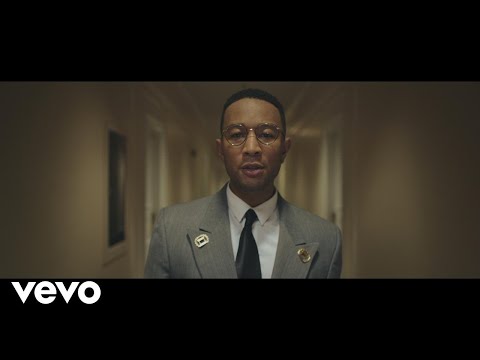
Penthouse Floor

Album: Darkness & Light (2016)
Play Video

Songfacts®:

  • The penthouse is the top floor of a hotel, which is reserved for people of a high social standing. John Legend sings on this funky empowering track about rising above.

    They float above the city lights
    Forget the truth inhale the lies
    Just enjoy the show
    They see us reaching for the sky
    Just ignore them to survive


    As Legend takes us up to the "Penthouse Floor," he has in mind the marginalized communities that are stuck on the ground, having been held back by the elite. Legend explained to the BBC that the song is "talking from the perspective of someone who lives on the wrong side of town, and is invisible to the powers that be."

    "The only time people notice his neighbourhood is when there's a police shooting and there's protesting in the streets," he added. "It's a reaction to housing segregation and the ghetto-isation of certain communities - how people ignore poverty and despair in certain neighbourhoods."
  • The song features a verse from Chance the Rapper. Legend explained during a listening party for Darkness And Light why he hooked up with the hip hop star.

    "I have a lot of friends from Chicago that have worked with him before," the singer shared. "I've been a fan for a while…I just really admire him. He's so young and bold. He's a really insightful artist."
  • This started out as a song about escaping your problems, but after Chance The Rapper came on board, it became a lot more political. Legend explained during a Darkness and Light listening party:

    "It talks about what's happening in our streets and how it's often ignored until something blows up, wanting to take your rightful place in society and finding a place where your voice and life matter. Chance and I were going back and forth as he was figuring out exactly what he was going to write about."
  • Chance starts his verse with a knock knock joke:

    I heard this old joke once, it was like, uh
    Knock knock, who's there, it's us, us who?
    Just us, who dis? Just playin'
    Just me, new phone, new hair, new era


    Legend said: "I love how he sets it up with him knocking on the door like an outsider, a fish out of water. But he's ascended for some reason or another. Both Chance and I come from pretty humble backgrounds but our talent and music have allowed us to get into rarefied air.

    You can tell Chance is dealing with a conflict in the verse in which he's talking about his folks being downstairs and still waiting in line. They've never been in these rooms. He gets to be here but he still feels like a bit of an outsider. If you listen closely, the verse is kind of profound. He does it in a kind of fun way but it's really smart as well. He captured the essence of what the song is about."
  • John Legend started writing the song with Greg Kurstin, co-writer of hits for the likes of Kelly Clarkson ("What Doesn't Kill You (Stronger)" and Adele ("Hello"). Legend recalled to Genius:

    "We were in his house, in his studio. He played me a groove that I liked, and I started writing vocal lines to it. The first lyrical hook that came to me was, 'We'll go to the penthouse floor.' The original idea for the song was a little more romantic and sexy and about the idea of wining and dining and balling with the person that you're interested in. Inviting them back to your place and saying, 'Let's enjoy the view from there. It's gonna be sexy. It's gonna be nice.' It represents us ascending to a blissful place.

    That was the original idea, but I decided to make The penthouse a little bit more deep than that and what you're leaving behind. It became a little more interesting as I lived with the song more. I worked with Blake Mills on it and some of my other team that was working with me on the album. We started to think more about the idea of ascension, but thinking more about ascension from something. From what's going on in the country, in our cities, in our neighborhoods. The idea of even though you have an aspiration to achieve a certain dream and to achieve a certain status, do you still remember where you've come from and pay attention to what's happening in places like where I came from and like a lot of other people come from?"
  • John Legend explained the track's inspiration: "The idea behind Trump's candidacy is making the American Dream exclusive to certain people," he said. "The idea behind this song is saying, 'No, it's not an exclusive dream. It's something that should be inclusive to everyone and available to everyone. Let's tear down these walls that people are trying to build up to separate us...'"

    "It started out just as a sexy groove about feeling good and aspiring to ascend," Legend continued. "In some ways it's still got that foundation, but hopefully, if people pay attention to the lyrics, it'll make them think about how we relate to each other, what success means and how we make the American Dream more inclusive."

Comments

Be the first to comment...

Editor's Picks

Who's Johnny, And Why Does He Show Up In So Many Songs

Who's Johnny, And Why Does He Show Up In So Many SongsSong Writing

For songwriters, Johnny represents the American man. He has been angry, cool, magic, a rebel and, of course, marching home.

Zakk Wylde

Zakk WyldeSongwriter Interviews

When he was playing Ozzfest with Black Label Society, a kid told Zakk he was the best Ozzy guitarist - Zakk had to correct him.

Art Alexakis of Everclear

Art Alexakis of EverclearSongwriter Interviews

The lead singer of Everclear, Art is also their primary songwriter.

John Lee Hooker

John Lee HookerSongwriter Interviews

Into the vaults for Bruce Pollock's 1984 conversation with the esteemed bluesman. Hooker talks about transforming a Tony Bennett classic and why you don't have to be sad and lonely to write the blues.

Tim McIlrath of Rise Against

Tim McIlrath of Rise AgainstSongwriter Interviews

Rise Against frontman Tim McIlrath explains the meanings behind some of their biggest songs and names the sci-fi books that have influenced him.

80s Video Director Jay Dubin

80s Video Director Jay DubinSong Writing

Billy Joel and Hall & Oates hated making videos, so they chose a director with similar contempt for the medium. That was Jay Dubin, and he has a lot to say on the subject.