
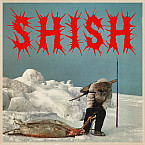


Album: Shish (2025)
Play Video

Songfacts®:

  • Angoon is a small Tlingit village of around 450 people on the southwest coast of Admiralty Island in southeastern Alaska, 78 nautical miles southwest of Juneau. Angoon has existed for over 1,000 years and today it is a subsistence fishing community and the only permanent settlement on Admiralty Island, serving as a gateway for canoe routes into the Admiralty Island National Monument.

    The tragedy at the heart of "Angoon" began on October 26, 1882, when a Tlingit shaman named Til'tlein was killed by a misfiring harpoon gun aboard a commercial trading vessel. In accordance with traditional Tlingit law, the villagers sought restitution by taking two white employees hostage and requesting a payment of 200 blankets. While the hostages were safely released upon the arrival of US Navy Commander Edgar C. Merriman, Merriman responded with a crushing show of military dominance, doubling the demand to 400 blankets.

    When the village could provide only 81, Merriman ordered his forces to open fire. The Navy bombarded Angoon with howitzers before landing Marines to burn the remaining structures to the ground. The devastation was total: at least six children perished from smoke inhalation, and every home, winter food store, and fishing canoe - save one - was destroyed. Left with no means to hunt or fish, elders reportedly sacrificed their own lives that winter to save what little food remained for the children.

    The attack, which included the looting of sacred ceremonial objects, was never sanctioned by the US government and was widely condemned even at the time as an act of excessive, punitive violence. Fast-forward 142 years to October 2024: the US Navy finally returned to Angoon to issue a formal, public apology, a gesture over a century and a half late, marking one of the rare instances of the US government formally atoning to an Indigenous American community.

    Portugal. The Man's song "Angoon" is a heavy, psychedelic indictment of imperial violence, commemorating the 1882 US Navy bombardment of the Tlingit village.
  • Released as the fourth and final single from Portugal. The Man's 10th album, Shish, on October 14, 2025, "Angoon" connects the 1882 bombardment to present-day immigration enforcement and land sovereignty debates, arguing that the logic of imperial dispossession did not end in the 19th century.

    "Genocide and land theft influence the song," Portugal. The Man frontman John Gourley told The Sun. "It's named after a Tlingit village bombed by the US military; a reminder imperial violence has happened on US soil and still happens."
  • The US Navy's formal apology to Angoon was delivered in October 2024, just one year before Portugal. The Man released this song. The timing suggests Gourley was paying close attention to that long-overdue reckoning.
  • Sitting at track 3 on Shish, "Angoon" is where the album pivots most explicitly toward political confrontation. Where "Denali" opens with Alaskan wonder and "Pittman Ralliers" deals in personal memory, "Angoon" names imperial violence by name, making clear that Shish's tribute to Alaska is inseparable from a reckoning with what was done to its Indigenous peoples. Gourley has positioned the album as a statement that "indigenous knowledge matters," and "Angoon" is where that statement becomes most direct and most urgent.

Comments

Be the first to comment...

Editor's Picks

Corey Hart

Corey HartSongwriter Interviews

The Canadian superstar talks about his sudden rise to fame, and tells the stories behind his hits "Sunglasses At Night," "Boy In The Box" and "Never Surrender."

Creedence Clearwater Revival

Creedence Clearwater RevivalFact or Fiction

Is "Have You Ever Seen the Rain" about Vietnam? Was John Fogerty really born on a Bayou? It's the CCR edition of Fact or Fiction.

Susanna Hoffs - "Eternal Flame"

Susanna Hoffs - "Eternal Flame"They're Playing My Song

The Prince-penned "Manic Monday" was the first song The Bangles heard coming from a car radio, but "Eternal Flame" is closest to Susanna's heart, perhaps because she sang it in "various states of undress."

Gene Simmons of Kiss

Gene Simmons of KissSongwriter Interviews

The Kiss rocker covers a lot of ground in this interview, including why there are no Kiss collaborations, and why the Rock Hall has "become a sham."

Joe Jackson

Joe JacksonSongwriter Interviews

Joe talks about the challenges of of making a Duke Ellington tribute album, and tells the stories behind some of his hits.

George Clinton

George ClintonSongwriter Interviews

When you free your mind, your ass may follow, but you have to make sure someone else doesn't program it while it's wide open.