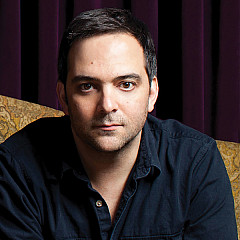
Scritti Politti's "Jacques Derrida" is Green Gartside's giddy, tongue-in-cheek pop song about being in love with the French philosopher, or, more accurately, about the intoxicating mixture of ideas, glamor and desire.
"It's about how powerful and contradictory the politics of desire are," Gartside told Sounds. "About being torn between all things glamorous and reactionary and all things glamorous and leftist. Then in the rap, it dispenses with both in favor of desire."
Jacques Derrida (1930–2004) was an Algerian-born French philosopher who developed deconstruction, a way of reading texts that questions the stability of language, meaning, and the hidden assumptions lurking underneath them. Naming a pop song after him was a very Derridean joke, playing with the gap between a name (the signifier) and the person or ideas behind it (the signified).
Gartside was unusually well-read for a pop star. "I put stuff from favorite philosophers in my lyrics," he told Uncut magazine, "because, outside of dressing up and getting wasted, reading philosophy was really all I was doing."
Derrida and Friedrich Nietzsche were his principal philosophical obsessions on Scritti Politti's debut album, Songs to Remember. Nietzsche inspired the opening track, "Asylums in Jerusalem," while Ludwig Wittgenstein also gets a nod in "Gettin' Havin' & Holdin'" via a reference to his philosophical work Tractatus Logico-Philosophicus. Most bands have enough trouble agreeing on a chorus.
Gartside met Derrida after the philosopher invited him to Paris for dinner at the Beaubourg. Derrida's students played him the single shortly after its release, and he had been keeping an eye on Gartside's press coverage in Britain. The meeting, however, proved a bit uncomfortable for the frontman.
"I didn't acquit myself at all well,"
Gartside told The Independent. "We were talking about music and I asked him why he had never written a book about music expressly, and he said that is the most difficult thing... Then he said how much he liked jazz. I had a little go at him. I had used his arguments against jazz in the past in relation to ideas of spontaneity, improvisation and unmediated expression."
The bridge feels as though it wandered in from an entirely different song:
He held it like a cigarette
Behind a squaddie's back
He held it so he hid its length
And so he hid its lack
The lyric stemmed from Gartside's teenage memories of watching older men at local folk clubs holding their penises while urinating. High philosophy, pop desire, post-punk and public toilets; Scritti Politti were nothing if not comprehensive.
Former Soft Machine drummer and avant-garde legend Robert Wyatt contributed keyboards to the track, nodding to Gartside's admiration for the British underground and Canterbury scene.
"Jacques Derrida" was released by Rough Trade on July 23, 1982, as a double A-side alongside "Asylums in Jerusalem." The artwork parodied a Courvoisier cognac label, following earlier sleeves that mimicked luxury products: Dunhill cigarettes for "
The Sweetest Girl" and Dior's Eau Sauvage for "Faithless." Gartside said the intention was to "convey a sense of a common, available thing which is classy, like our records now."
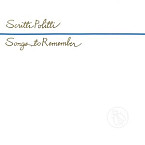
Although much of Songs to Remember was recorded by August 1981, Rough Trade delayed its release for a year to build momentum with singles. It finally appeared on September 3, 1982, reaching #12 on the UK Albums Chart.
Songs to Remember marked Gartside's complete transformation of Scritti Politti from a scrappy DIY outfit (heard on early tracks like "Skank Bloc Bologna") into a polished blend of pop, soul, and reggae. That shift came after a physical and mental collapse in 1980 forced Gartside into a nine-month convalescence in Wales, where he rethought both the band's politics and its musical direction.
The result was an album where revolutionary theory, pristine pop melodies, luxury-brand packaging, and a song about having a crush on Jacques Derrida's ideas somehow occupy the same space. It's hard to imagine Derrida himself objecting to the contradiction.