Flaming Lips lead singer Wayne Coyne lost his father to cancer in 1997, which inspired the lyric about two scientists racing for a cure. The "race for the prize" is the quest to cure the disease.
"I try to look at myself as a scientist of some kind," Coyne explained. "So many times people look at themselves as artists and anything that comes out of their fingertips, or ass, is good. Scientists don't have that luxury. They can't just say, 'I have the cure for cancer and it's pink with dots on it, isn't it great?' It actually has to work."
"Race For The Prize" is a live signature for the band, played at just about every show. Coyne will sometimes go silent to listen to the crowd sing - they always know the words.
The soundscape on this track is built on a string section instead of guitars. The band was doing a lot of sonic exploration at the time.
The band recorded a new version of this song as "Thunder Up! Racing for the Prize" in 2012 to honor their hometown NBA team, the Oklahoma City Thunder, which was making an impressive playoff run. The Thunder ended up losing to the Miami Heat in the finals.
On June 10, 2020, the Flaming Lips appeared on The Late Show With Stephen Colbert, with both band and audience members inside the kind of bubbles Wayne Coyne uses during concerts. It was an innovative, if cumbersome, way of playing to a crowd in the age of coronavirus.
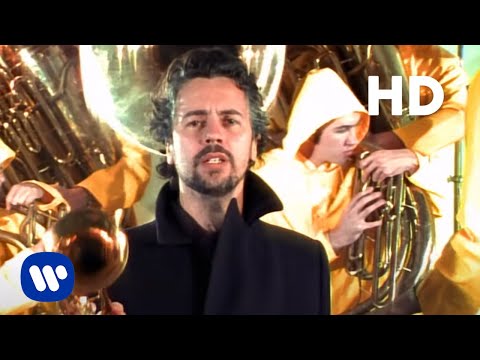
In the music video, directed by Wayne Coyne and Bradley Beesley, an Olympic runner (Wayne's brother Ken) is being tracked by men in yellow suits while a motorcyclist (Wayne's brother Marty) tries to run him down. Meanwhile, the band plays in a garden auditorium backed by a tuba section. In the notes for The Soft Bulletin 5.1 DVD, Wayne said he and his brothers were enthralled by "the plight of the long distance runner" during the Olympic games in the late '60s. He explained: "There was something epic in the struggle of the individual that we were drawn to and, I believe, the sound of 'Race for the Prize' must have triggered these hallucinogenic memories from deep inside my reptilian child mind."
Aside from Wayne's brothers, the singer's nephew Dennis also cameos as one of the yellow-raincoat runners.
Steven Drozd, the band's drummer, wrote the melody back in 1993 during the Transmissions From The Satellite Heart sessions, but Wayne wasn't impressed. "It sounded like a car commercial, or the sort of thing that you'd hear at the beginning of a football game," he explained in the band's bio, Staring At Sound.
But when Steven used a keyboard patch to emulate '70s-style Mellotron strings, it sparked Wayne's imagination. "Now it was a whole other story. Suddenly it seemed like it could be Frank Sinatra on one side and Led Zeppelin on the other. During that time I started to feel that we take a lot from the world, but we haven't really stepped up to the plate and said, 'Here's what we have got to offer.' We act like this music is the biggest deal ever, but it's all self-serving: None of it helps the world. Our generation never cared about these things; it was always about us. Like with cancer, we think, 'Someone is going to find a cure.' Not us, but someone, and in fact, it's never going to get done if we don't do it."
The album title was originally going to be The Soft Bullet In. Wayne told Uncut in 1999, "Like, I'm shooting you through the head, but you won't feel a thing."
The album's bright yellow cover art features a young man dancing with his own silhouette. The original black-and-white photo, titled "The Acid Test: Neal Cassady," by Lawrence Schiller, accompanied a Life magazine article about LSD in 1966. Cassady was an iconic figure of the Beat generation and inspired the main character in Jack Kerouac's 1957 novel On The Road. Schiller caught up with Cassady during an "Acid Test," an event that featured music and LSD-laced Kool-Aid, and snapped an impromptu photo of him dancing with his shadow on Sunset Boulevard.
Wayne remembered the photo when the band was working on Soft Bulletin. "I'd seen it in a Life hardback I picked up at a thrift store maybe 10 years earlier, and I always thought it would be a cool album cover," he told The Guardian in 2011. "I think I was actually making music that sounded like that photo, or what I thought the photo sounded like, anyway."
He added: "To me, the photo represents a person going into the unknown - the unknown within themselves."