
Adventures In A Yorkshire Landscape

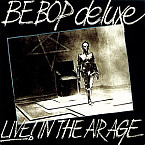
Album: Live! In the Air Age (1974)
Play Video

Songfacts®:

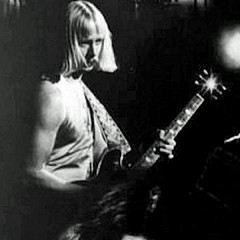
  • "Adventures in a Yorkshire Landscape" is widely considered the magnum opus of guitarist and songwriter Bill Nelson during his tenure with Be-Bop Deluxe. The song first appeared on the band's 1974 debut album, Axe Victim, back when they were still wearing glam-rock eyeliner and trying to decide whether they wanted to be Bowie in platform boots or Roxy Music in a lab coat.
  • Nelson, born and bred in Wakefield in the West Riding of Yorkshire, turned the song into a sort of northern travelogue filtered through an Art-Rock National Trust brochure. You get "buildings pulled down," "pylons that crack," and "council house mystics." Nelson romanticizes the decay, elevating the grim post-industrial reality into something mythical; "singing sad wires" and "chimneys of black" suddenly sound like tourist attractions you'd pull over to photograph.
  • One of the quietly radical things about the track is that it pushes back against the London-centric gravitational pull of British rock in the 1970s. Here was a band planting a flag in the North, turning the stereotype of "grim up north" into a lost England glimpsed at dusk.
  • Bill Nelson channels the school of John Betjeman poetry on "Yorkshire Landscape."

    "I wasn't consciously thinking of Betjeman for that song, I was just trying to capture a snapshot of an England that was disappearing," he told Uncut magazine. "But he was one of my heroes, and I would have had his Banana Blush album around that time."

    If you want to hear another songwriter raid the Betjeman cupboard, listen to Jamie T's "Sheila," which samples the poet's "The Cockney Amorist."
  • On Axe Victim, "Yorkshire Landscape" is a 6/8 ballad with acoustic textures and a low-key vocal. It's the quiet track on an album otherwise full of glam-rock and art rock.
  • Ask any fan and they'll tell you: the real version lives on Live! In the Air Age, recorded in 1977, when Be-Bop Deluxe had swapped glitter for futurism and were sliding into sleek art-rock modernity. Live, Nelson slowed the song way down and cracked it open like a geode. Suddenly it became a showcase for his molten guitar tone: fluid, sustain-heavy, and melodic.

    "I'm not an academic, trained player, nor do I read music or have any musical theory to boast of, but I've always loved jazz," Nelson told Vintage Guitar magazine.

    As a teen, he was absorbing Wes Montgomery, Joe Pass, Kenny Burrell, Jim Hall, and Charlie Byrd, while also inhaling Chet Atkins, Scotty Moore, Duane Eddy, and The Shadows.

    "'Yorkshire Landscape' evolved into something where the band could open up and improvise," he continued. "So my solos for that song leaned in that jazzier direction."

    The result? A personal epic disguised as a postcard from Wakefield, as if to say: even ruins can sing, if you know how to listen.

Comments

Be the first to comment...

Editor's Picks

Eric Clapton

Eric ClaptonFact or Fiction

Did Eric Clapton really write "Cocaine" while on cocaine? This question and more in the Clapton edition of Fact or Fiction.

Trans Soul Rebels: Songs About Transgenderism

Trans Soul Rebels: Songs About TransgenderismSong Writing

A history of songs dealing with transgender issues, featuring Pink Floyd, David Bowie, Morrissey and Green Day.

John Waite

John WaiteSongwriter Interviews

"Missing You" was a spontaneous outpouring of emotion triggered by a phone call. John tells that story and explains what MTV meant to his career.

The Truth Is Out There: A History of Alien Songs

The Truth Is Out There: A History of Alien SongsSong Writing

The trail runs from flying saucer songs in the '50s, through Bowie, blink-182 and Katy Perry.

Deconstructing Doors Songs With The Author Of The Doors Examined

Deconstructing Doors Songs With The Author Of The Doors ExaminedSong Writing

Doors expert Jim Cherry, author of The Doors Examined, talks about some of their defining songs and exposes some Jim Morrison myths.

Ian Anderson: "The delight in making music is that you don't have a formula"

Ian Anderson: "The delight in making music is that you don't have a formula"Songwriter Interviews

Ian talks about his 3 or 4 blatant attempts to write a pop song, and also the ones he most connected with, including "Locomotive Breath."