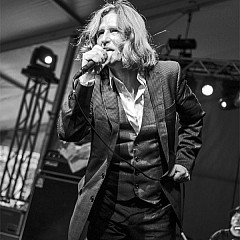
Chris Rea

Chris Rea Artistfacts

  • March 4, 1951-December 22, 2025
  • He sold somewhere in the realm of 30 million albums, but Rea didn't look or act like a famous musician. In the '70s and '80s, he was often mistaken for a stagehand at TV appearances, and sometimes even at his own concerts.
  • In his native UK, he's best known for his 10th album, The Road to Hell, which went to #1 after it was released in 1989. Written in a week, the album deals with the isolation and ennui he felt after buying a house on the shore and commuting to London.
  • He was a top slide guitarist, but didn't start playing the instrument until he was 22.
  • An auto racing enthusiast, Rea owned Ferraris and other sports cars, and often raced on the amateur circuit. Many of his songs contain motoring imagery, although they're not really about the cars. "It's about people in cars, it's not about the car itself," he said in a Songfacts interview.
  • For a short time, he was bandmates with David Coverdale - they were in a group called Magdalene. He later played with Rod Argent in the band Deltics.
  • A turning point for Rea came with his 1985 album Shamrock Diaries, which was inspired by his time in Ireland and his Irish heritage. To this point, he was making music with an eye toward commercial success, but Shamrock Diaries made no effort to follow a trend or reach a specific market. Surprisingly, it sold well, as did his next efforts, which were also done on his terms. "Without the Irish and Shamrock Diaries there would have been no Road To Hell," Rea said.
  • His mother died in 1983 the day after his second daughter, Josephine, was born.
  • He wrote and produced the 1996 film La Passione, about a 10-year-old English boy with a passion for auto racing. Much of it is based on Rea's experiences, but he said it's not autobiographical.
  • He had a number of health issues, starting in 1994 when he was diagnosed with pancreatic cancer. After having his pancreas and some of his colon removed, he became a diabetic. He later had several surgeries to deal with problems with his digestive system.
  • Inspired by Pink Floyd, he put on an atypically elaborate stage show when he toured for The Road to Hell album. At the end of each show, he and the band would disappear behind a puff of smoke, replaced with a cube as seen on the album cover.
  • Chris Rea passed away on December 22, 2025, following a short illness. The day before his death, he shared a final affecting post: a photograph of a car edging along a snowy motorway, accompanied by a road sign and the caption, "Driving home for Christmas with a thousand memories."

    He added a characteristically wry aside: "Top to toe in tailbacks. If it's a white Christmas, let's hope the journey's a smooth one"; a farewell that reads like one last snapshot from the road that defined his most enduring song.

Comments

Be the first to comment...

Editor's Picks

Supertramp founder Roger Hodgson

Supertramp founder Roger HodgsonSongwriter Interviews

Roger tells the stories behind some of his biggest hits, including "Give a Little Bit," "Take the Long Way Home" and "The Logical Song."

Barney Hoskyns Explores The Forgotten History Of Woodstock, New York

Barney Hoskyns Explores The Forgotten History Of Woodstock, New YorkSong Writing

Our chat with Barney Hoskyns, who covers the wild years of Woodstock - the town, not the festival - in his book Small Town Talk.

Classic Metal

Classic MetalFact or Fiction

Ozzy, Guns N' Roses, Judas Priest and even Michael Bolton show up in this Classic Metal quiz.

Millie Jackson

Millie JacksonSongwriter Interviews

Outrageously gifted and just plain outrageous, Millie is an R&B and Rap innovator.

Verdine White of Earth, Wind & Fire

Verdine White of Earth, Wind & FireSongwriter Interviews

The longtime bassist of Earth, Wind & Fire discusses how his band came to do a holiday album, and offers insight into some of the greatest dance/soul tunes of all-time.

Allen Toussaint - "Southern Nights"

Allen Toussaint - "Southern Nights"They're Playing My Song

A song he wrote and recorded from "sheer spiritual inspiration," Allen's didn't think "Southern Nights" had hit potential until Glen Campbell took it to #1 two years later.