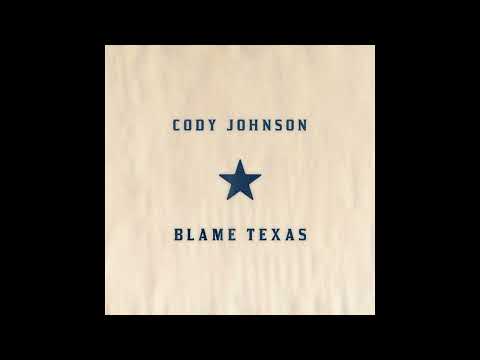
Blame Texas

Album: released as a single (2026)
Play Video

Songfacts®:

  • With "Blame Texas," Cody Johnson would at least make the podium for the most creative use of state pride as an emotional smokescreen. The song begins like a cheerful tourist brochure for the Lone Star State as Johnson ticks off the usual Texas calling cards: chasing tequila with a beer, tipping his hat to George Strait instead of Elvis Presley, and generally behaving like a man who considers a cowboy hat less an accessory and more a permanent architectural feature of the skull.

    But then the chorus arrives and we realize the song is in fact about a relationship that went sideways. Johnson confesses that the one thing that really mattered - losing the woman he loved - was entirely his own doing, and though he wishes he could, he can't blame Texas.
  • Johnson surprise-dropped "Blame Texas" on March 2, 2026, with no prior promotion or announcement. The date was deliberate: March 2 is Texas Independence Day, commemorating the adoption of the Texas Declaration of Independence on March 2, 1836, when 59 delegates formally declared settlers in Mexican Texas independent of Mexico. Johnson's only note accompanying the release was posted to Instagram: "We had so much fun cuttin' this one in the studio, I couldn't keep it to myself. Had to let y'all have it."
  • Johnson didn't write "Blame Texas": it was penned by Ashley Gorley, Josh Phillips, Beau Bailey, and Casey Brown. The track was produced by Trent Willmon, Johnson's longtime collaborator, who has helmed every CoJo album since 2014's Cowboy Like Me.

    Ashley Gorley, inducted into the Songwriters Hall of Fame in 2025, is one of Nashville's most prolific hitmakers, with credits spanning Morgan Wallen, Post Malone, Chris Stapleton, and Carrie Underwood.

    Josh Phillips wrote "Dirt Cheap," one of the standout tracks on Johnson's Leather album (2023) and a subsequent radio single. The route "Dirt Cheap" took to Johnson is almost certainly the same route "Blame Texas" followed: Phillips sent the song to his longtime friend and Johnson's producer Trent Willmon, who in turn played it for Johnson.

    Beau Bailey arrived in Nashville from Louisiana after a pop-rock band deal evaporated during COVID. Since then he's landed cuts like "Favorite Country Song" for Hardy and "Stay Country Or Die Tryin'" for Blake Shelton.

    Casey Brown is signed to Gorley's publishing company Tape Room Music, which explains how the two frequently end up in the same songwriting sessions. He has credits on songs by Russell Dickerson, Megan Moroney, Dierks Bentley, and Tyler Hubbard.
  • The full session band on "Blame Texas" is a who's who of Nashville session players:

    Trey Keller: background vocals
    James Mitchell: electric guitar
    Justin Ostrander: electric guitar
    Tim Galloway: acoustic guitar
    Scotty Sanders: pedal steel guitar
    Jimmie Lee Sloas: bass
    Jenee Fleenor: fiddle
    Jim "Moose" Brown: Hammond B3 organ and piano
    Jerry Roe: drums

Comments

Be the first to comment...

Editor's Picks

Randy Houser

Randy HouserSongwriter Interviews

The "How Country Feels" singer talks Skynyrd and songwriting.

Amy Lee of Evanescence

Amy Lee of EvanescenceSongwriter Interviews

The Evanescence frontwoman on the songs that have shifted meaning and her foray into kids' music.
Ralph Casale  - Session Pro

Ralph Casale - Session ProSongwriter Interviews

A top New York studio musician, Ralph played guitar on many '60s hits, including "Lightnin' Strikes," "A Lover's Concerto" and "I Am A Rock."
80s Music Quiz 1

80s Music Quiz 1Music Quiz

MTV, a popular TV theme song and Madonna all show up in this '80s music quiz.
The Police

The PoliceFact or Fiction

Do their first three albums have French titles? Is "De Do Do Do, De Da Da Da" really meaningless? See if you can tell in this Fact or Fiction.

Holly Knight ("The Best," "Love Is A Battlefield")

Holly Knight ("The Best," "Love Is A Battlefield")Songwriter Interviews

Holly Knight talks about some of the hit songs she wrote, including "The Warrior," "Never" and "The Best," and explains some songwriting philosophy, including how to think of a bridge.