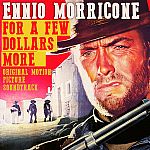
For A Few Dollars More - Main Theme

Album: For A Few Dollars More soundtrack (1965)
Play Video

Songfacts®:

  • In the sequel to Sergio Leone's Spaghetti Western A Fistful Of Dollars, Clint Eastwood returns as the unnamed stranger who is tasked with hunting down an escaped convict who carries a musical pocket watch.

    Once again, the score was composed by Ennio Morricone and its main theme is reminiscent of the lonely whistled melody of the first film. In fact, Leone was so taken with the previous theme, he wanted to use it again for the sequel, but Morricone convinced him to use something new that evoked the same atmospheres. It even used the same performers: Alessandro Alessandroni whistling and Bruno Battisti D'Amario playing electric guitar.

    "The musical theme is new, but I kept Alessandro's whistle and D'Amario's electric guitar for the leading parts," Morricone confirmed in his 2019 autobiography. "For the initial choir, which was already present in the previous film, this time I used guttural sounds instead of words, to emphasize an even more radical 'primitivism.' For the same reason, I used the marranzano, an instrument that is typical of the northern African tradition, as well as of Sicily and Korea, played by the exceptional Salvatore Schilliro."
  • Morricone used different musical elements to reflect the qualities of the film's characters. In A Fistful Of Dollars, the whistle and flute were used because Eastwood's gunslinger was "fleeting and fast just like the wind." In For A Few Dollars More, he wanted to incorporate the marranzano, which is also known as a Jew's harp, into the theme to signify the rough side of Eastwood's bounty hunting partner, Colonel Douglas Mortimer (Lee Van Cleef).
  • The monotone marranzano was difficult to integrate into the piece. He broke down the process in his autobiography: "The entire film is in D minor, as is the previous, and the part of the Jew's harp included five tones: D, F, G, Bb, and C, the fundamentals of the harmonics I was employing. Given that it is a monotone instrument, capable of producing only one pitch, we had to use five different instruments and record the sounds on separate tracks. Moreover, as we had a very modest three-track tape recorder, it took a lot of tape splicing to obtain a fluid performance. Our sound technician, Pino Mastroianni, fortunately proved to be very patient."
  • This was used in the movies Couples Retreat (2009), The Fantastic Mr. Fox (2009), Kick-Ass (2010), and Return Of The Killer Tomatoes! (1988). It was also used on the TV series Eastbound & Down in the 2010 episode "Chapter 11."

Comments

Be the first to comment...

Editor's Picks

Danny Kortchmar

Danny KortchmarSongwriter Interviews

Danny played guitar on Sweet Baby James, Tapestry, and Running On Empty. He also co-wrote many hit songs, including "Dirty Laundry," "Sunset Grill" and "Tender Is The Night."

John Lee Hooker

John Lee HookerSongwriter Interviews

Into the vaults for Bruce Pollock's 1984 conversation with the esteemed bluesman. Hooker talks about transforming a Tony Bennett classic and why you don't have to be sad and lonely to write the blues.

Who Wrote That Song?

Who Wrote That Song?Music Quiz

Do you know who wrote Patti Smith's biggest hit? How about the Grease theme song? See if you can match the song to the writer.

The Punk Photography of Chris Stein

The Punk Photography of Chris SteinSong Writing

Chris Stein of Blondie shares photos and stories from his book about the New York City punk scene.

Ian Astbury of The Cult

Ian Astbury of The CultSongwriter Interviews

The Cult frontman tells who the "Fire Woman" is, and talks about performing with the new version of The Doors.

Donny Osmond

Donny OsmondSongwriter Interviews

Donny Osmond talks about his biggest hits, his Vegas show, and the fan who taught him to take "Puppy Love" seriously.