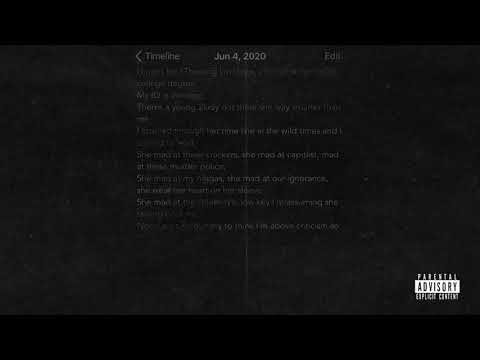
Snow On Tha Bluff

Album: single release only (2020)
Charted: 54
Play Video

Songfacts®:

  • Here, J. Cole delivers a single continuous verse that speaks on a range of topics including capitalism, celebrity culture, police brutality, wealth inequality, and racism.
  • Cole addresses the first part of the track to Chicago rapper and poet Noname, an outspoken political activist who has frequently stated her opposition to capitalism and celebrity culture. The lines are likely Cole's response after NoName called out top selling rappers for their social media silence amidst the protests following the killing of George Floyd. Without ever actually namedropping her, he praises the "young lady" for her intelligence but adds her methods may be less effective because of her "queen tone."
  • Lambasted on social media for his criticism of Noname, Cole responded on Twitter: "I stand behind every word of the song that dropped last night," he began. "Right or wrong I can't say, but I can say it was honest."

    Cole went on to praise Noname as a leader, saying, "She has done and is doing the reading and the listening and the learning on the path that she truly believes is the correct one for our people."

    He concluded: "I appreciate her and others like her because they challenge my beliefs and I feel that in these times that's important. We may not agree with each other, but we gotta be gentle with each other."
  • Cole has worked with Noname before. Both contributed uncredited vocals to Donnie Trumpet & The Social Experiment's 2015 track "Warm Enough."
  • Cole named the song after a 2011 movie Snow on tha Bluff, which tells the story of real life Atlanta robber and crack dealer Curtis Snow. The film's title refers to the protagonist, and to Atlanta's neighborhood The Bluff, which is infamous for crime and drug dealing. The motion picture's realistic drama documentary style gives the impression that the footage showing crimes being committed actually happened, but after investigation they were discovered to be fictional.

    But damn, why I feel faker than Snow on Tha Bluff?
    Well, maybe 'cause deep down I know I ain't doing enough


    Cole is wondering if there is some truth in Noname's criticism and worries that like the titular movie he is a fake. His songs like "Neighbors" discuss African-American plight, and many of his fans see him as a voice of his generation, but the rapper feels he has come up short in supporting the Black Lives Matter movement.

    Cole may be a bit hard on himself as he did take an active role in the protests in his hometown of Fayetteville, North Carolina.
  • J Cole self-produced the dreamy track with Kelvin Wooten (Anthony Hamilton's "Cool," Jill Scott's "So In Love").
  • Noname dropped an answer song called "Song 33" two days after "Snow" was released. On that track, she attacks Cole for focusing on her instead of more relevant topics.

Comments

Be the first to comment...

Editor's Picks

Does Jimmy Page Worship The Devil? A Look at Satanism in Rock

Does Jimmy Page Worship The Devil? A Look at Satanism in RockSong Writing

We ring the Hell's Bells to see what songs and rockers are sincere in their Satanism, and how much of it is an act.

American Hits With Foreign Titles

American Hits With Foreign TitlesSong Writing

What are the biggest US hits with French, Spanish (not "Rico Suave"), Italian, Scottish, Greek, and Japanese titles?
Part of Their World: The Stories and Songs of 13 Disney Princesses

Part of Their World: The Stories and Songs of 13 Disney PrincessesSong Writing

From "Some Day My Prince Will Come" to "Let It Go" - how Disney princess songs (and the women who sing them) have evolved.
Tim McIlrath of Rise Against

Tim McIlrath of Rise AgainstSongwriter Interviews

Rise Against frontman Tim McIlrath explains the meanings behind some of their biggest songs and names the sci-fi books that have influenced him.
Hawksley Workman

Hawksley WorkmanSongwriter Interviews

One of Canada's most popular and eclectic performers, Hawksley tells stories about his oldest songs, his plentiful side projects, and the ways that he keeps his songwriting fresh.
Dave Pirner of Soul Asylum

Dave Pirner of Soul AsylumSongwriter Interviews

Dave explains how the video appropriated the meaning of "Runaway Train," and what he thought of getting parodied by Weird Al.