
Cathedrals

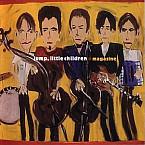
Album: Magazine (1998)
Play Video

Songfacts®:

  • Jump, Little Children is an indie-rock band who released their major label debut, Magazine, in 1998. The album included the moody cello tune "Cathedrals," which received nationwide airplay and earned the band a following. According to frontman Jay Clifford, the song is about former bandmate Christopher Pollen, who left the group in 1993 to join a religious cult. He told Songfacts the story in a 2022 interview:

    "He was Catholic. He had some real difficulties functioning within normal society. He had a very unhealthy relationship with himself, and a shattered relationship with his friends and his parents. Watching him devolve out of society into this smaller world of a cult is where the song 'Cathedrals' comes from. The idea that you can walk through these gothic cathedrals and feel a sense of awe but also feel intimidation, an institutional ominousness that makes you want to figure out where you fit in.

    Watching him go through this desperate journey to find where he fits into this world is where that song came from. It was a strange kind of reverse metamorphosis to watch him sort of drink this poison. This ideology that backed him out of relationships and a healthy life in the normal world. It was a really difficult thing to watch."
  • The band formed in 1991 after its members met at the North Carolina School of the Arts in Winston-Salem, North Carolina. They started out playing Irish music and even traveled to Ireland in the winter of 1992 to hone their craft. Not long after coming back home and spending a fruitful summer in Charleston, South Carolina, they decided to relocate to Boston for six months because "there's more Irish people in Boston than there are in Ireland."

    They issued a self-titled cassette that featured a mix of original songs and traditional Irish tunes, but really started to gain traction when they incorporated alternative rock into their sound and started regularly touring throughout the Southeast. After releasing the live EP Buzz in 1997, they caught the attention of several record labels and opted to sign with Breaking Records, a subsidiary of Atlantic founded by Hootie & The Blowfish.
  • The band takes its name from a blues tune written by Leroy Dallas and popularly covered by Sonny Terry and Brownie McGhee, a blues duo from North Carolina. "They'd play a lot of the tobacco barns back in the early part of the 20th century," Clifford told Songfacts. "It's amazing stuff. Acoustic guitar, blues, and harmonica. And they have a song called 'Jump, Little Children.' The central idea is that mama and papa are gone, so let's just have fun."
  • This was used on the TV series Everwood ("Home" - 2003) and The Society ("Our Town" - 2019).

Comments

Be the first to comment...

Editor's Picks

Producer Ron Nevison

Producer Ron NevisonSong Writing

Ron Nevison explains in very clear terms the Quadrophenia concept and how Heart staged their resurgence after being dropped by their record company.

Creedence Clearwater Revival

Creedence Clearwater RevivalFact or Fiction

Is "Have You Ever Seen the Rain" about Vietnam? Was John Fogerty really born on a Bayou? It's the CCR edition of Fact or Fiction.

Glen Phillips of Toad the Wet Sprocket

Glen Phillips of Toad the Wet SprocketSongwriter Interviews

The "All I Want" singer went through a long depression, playing some shows when he didn't want to be alive.

Tom Keifer of Cinderella

Tom Keifer of CinderellaSongwriter Interviews

Tom talks about the evolution of Cinderella's songs through their first three albums, and how he writes as a solo artist.

Real or Spinal Tap

Real or Spinal TapMusic Quiz

They sang about pink torpedoes and rocking you tonight tonight, but some real lyrics are just as ridiculous. See if you can tell which lyrics are real and which are Spinal Tap in this lyrics quiz.

Jon Anderson

Jon AndersonSongwriter Interviews

Jon Anderson breaks down the Yes classic "Seen All Good People" and talks about his 1000 Hands album, which features Chick Corea, Rick Derringer, Ian Anderson, and many other luminaries.