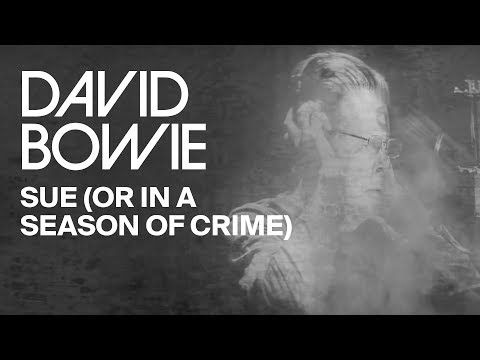
Sue (Or In A Season Of Crime)

Album: Nothing Has Changed - The Very Best of Bowie (2014)
Play Video

Songfacts®:

  • The lead single from David Bowie's compilation album, Nothing Has Changed - The Very Best of Bowie, it was recorded especially for the retrospective with longtime collaborator Tony Visconti. The tune was laid down during the Summer of 2014 in New York with the Maria Schneider Orchestra.
  • The genesis of the song lay in a visit by Bowie and Tony Visconti to The Birdland jazz club in New York, when they went to see Maria Schneider and her 17-piece big band. "I was totally floored by the beauty and power of her music," Visconti recalled to NME. "I learned she was a student of Gil Evans and worked as his score copyist. Gil Evans and Stan Kenton were jazz composers David and I were both very fond of, and so was Maria, apparently."

    Bowie decided that he would like to collaborate with Schneider. "Initially we worked from David's demo of the untitled song," Visconti told NME. "Over the course of three long sessions in a rehearsal studio, (Maria) and core members of the band jammed over the bassline for several hours. After this, Maria and David met to finalise the arrangement and structure, and Maria kept me in the picture by sending me musical scores of her updates – her writing was very meticulous."

    "When the day arrived to record the piece with the full 17-piece band," he added, "David handed lyrics to Maria, myself and our engineer – and it was only then we learned it was called 'Sue.'"
  • Bowie has rarely touched on jazz before. He once collaborated with jazz fusion band Pat Metheny Group for the 1985 cut "This Is Not America." However, the song for The Falcon and the Snowman soundtrack was a mid-tempo ballad with few jazz elements. In addition, Jazz trumpeter Lester Bowie (no relation) contributed to four tracks from the 1993 Black Tie White Noise set.

    The Thin White Duke has occasionally used jazz in an ornamental way, such as Mike Garson's improvised piano solo on Aladdin Sane's title track.
  • The song was re-recorded for Blackstar at The Magic Shop in New York City with a group of New York jazz musicians. "It wasn't actually spoken out loud, but we were going to make a David Bowie album with jazz musicians, but they weren't necessarily going to play jazz," co-producer Tony Visconti told NPR. "If we used rock musicians trying to play jazz, it would have been a very different album."
  • LCD Soundsystem founder James Murphy played percussion on both this track and "Girl Loves Me." Murphy was originally scheduled to be one of Blackstar's producers before backing out. "I played a little percussion. I was supposed to do a lot more but I got overwhelmed," he admitted to BBC Radio 1's Annie Mac.

    Walking into the studio Murphy felt a lack of confidence in his abilities: "It takes a different kind of person than me to walk into that room and be like, I know exactly… I belong here, I should definitely insert myself in this relationship because they just can't manage to make a record without me," he said.

Comments

Be the first to comment...

Editor's Picks

Narada Michael Walden - "Freeway of Love"

Narada Michael Walden - "Freeway of Love"They're Playing My Song

As a songwriter and producer, Narada had hits with Aretha Franklin, Whitney Houston, Mariah Carey and Starship. But what song does he feel had the greatest impact on his career?

Randy Houser

Randy HouserSongwriter Interviews

The "How Country Feels" singer talks Skynyrd and songwriting.

Gary Lewis

Gary LewisSongwriter Interviews

Gary Lewis and the Playboys had seven Top 10 hits despite competition from The Beatles. Gary talks about the hits, his famous father, and getting drafted.

Eric Clapton

Eric ClaptonFact or Fiction

Did Eric Clapton really write "Cocaine" while on cocaine? This question and more in the Clapton edition of Fact or Fiction.

Al Kooper

Al KooperSongwriter Interviews

Kooper produced Lynyrd Skynyrd, played with Dylan and the Stones, and formed BS&T.

Brenda Russell

Brenda RussellSongwriter Interviews

Brenda talks about the inspiration that drove her to write hit songs like "Get Here" and "Piano in the Dark," and why a lack of formal music training can be a songwriter's best asset.