The Knife

Album: Daughter from Hell (2026)
Charted: 109
Play Video

Songfacts®:

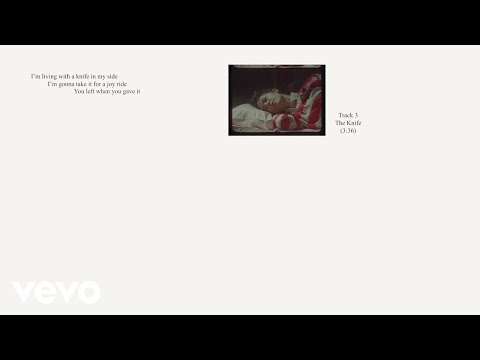
  • "The Knife" is about heartbreak that refuses to fade, a wound Gracie Abrams deliberately keeps instead of letting it heal. Though others are "daring" her to pull the knife out, she refuses, even taking it along for a "joy ride." It's an unsettling image, but a deliberate one: letting the knife go would mean letting go of the last tangible connection to what was lost.
  • As the third track on Daughter From Hell, "The Knife" arrives early in the album's sequence, following "Hit The Wall" and "Death Wish," and coming immediately before the title track. It acts as an early emotional anchor, establishing the album's interest in the complicated, unglamorous interior of heartbreak rather than the more cinematic drama that usually accompanies it. Abrams isn't interested in simply showing us she is hurt; she wants to examine why she keeps the wound open.
  • The knife is a recurring image throughout Daughter From Hell, creating a visual language that connects the album's songs. Other examples of the blade imagery include:

    On "Death Wish," the lyric about twisting "the knife with a smile while you kill me" uses the same weapon imagery for a toxic relationship.

    On "Good Reason" the "sharp knife" is a metaphor for the way the relationship was repeatedly damaged, even though the partner was kind and would "bleed" to spare her feelings.

    On "Men Like You," Abrams sings about blades "embedded in her back, poised to be turned by a duplicitous companion," extending the knife-in-the-back betrayal image to a friendship rather than a romance.

    This threading of blade and wound imagery across multiple tracks gives the album a unifying visual language for heartbreak, betrayal, and self-inflicted emotional stasis.
  • Abrams has not identified the ex who inspired "The Knife," and there is no official confirmation that it refers to any particular former partner. She was previously in a five-year relationship with producer Blake Slatkin, which provided inspiration for much of Good Riddance, and was later linked to Hayes Bradley. It is possible that the song draws on the lingering aftermath of one of those relationships, but Abrams has kept the subject anonymous. Instead, the knife becomes a broader symbol for the kind of heartbreak that remains embedded long after the relationship has ended, whether the person holding the blade is a careless lover, a two-faced friend, or, occasionally, oneself.

Comments

Be the first to comment...

Editor's Picks

George Clinton

George ClintonSongwriter Interviews

When you free your mind, your ass may follow, but you have to make sure someone else doesn't program it while it's wide open.

Curt Kirkwood of Meat Puppets

Curt Kirkwood of Meat PuppetsSongwriter Interviews

The (Meat)puppetmaster takes us through songs like "Lake Of Fire" and "Backwater," and talks about performing with Kurt Cobain on MTV Unplugged.

Women Who Rock

Women Who RockSong Writing

Evelyn McDonnell, editor of the book Women Who Rock, on why the Supremes are just as important as Bob Dylan.

Petula Clark

Petula ClarkSongwriter Interviews

Petula talks about her hits "Downtown" and "Don't Sleep In The Subway," and explains her Michael Jackson connection.

Eric Clapton

Eric ClaptonFact or Fiction

Did Eric Clapton really write "Cocaine" while on cocaine? This question and more in the Clapton edition of Fact or Fiction.

Evolution Of The Prince Symbol

Evolution Of The Prince SymbolSong Writing

The evolution of the symbol that was Prince's name from 1993-2000.