Internet Girl

Album: released as a single (2026)
Charted: 24 29
Play Video

Songfacts®:

  • Formed in 2023 via the Dream Academy competition, Katseye were uploaded into the pop world. They are a band born in tabs, timelines, and comment sections; the kind of act people recognize mid-scroll. Released on January 2, 2026, "Internet Girl" serves as a manifesto for chronic online culture, unpacking irony, online outrage, and the exhausting performance of self in public spaces.
  • Unlike many of the group's earlier releases (both "Gnarly" and "Gabriela" were originally written for other artists) "Internet Girl" was the first song written specifically for Katseye, shifting toward material built around their lived reality. Mattman & Robin, Justin Tranter, Livvi Franc, and Shawn Wasabi wrote the track, a lineup well-versed in pop with opinions.
  • The chorus sparked debate almost immediately

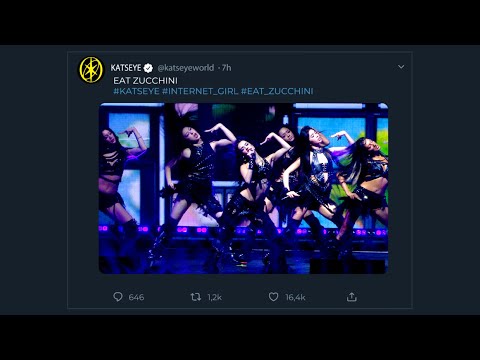
    Eat zucchini
    Eat zucchini
    Do you read me?
    Like the emoji?


    Some fans heard a jab at diet culture and the relentless policing of women's bodies. Others interpreted it as a deliberately PG-coded euphemism suggesting that haters should, politely speaking, pipe down. The follow-up line - "Do you read me?" - feels like a wink through gritted teeth.
  • One of the song's writers, Justin Tranter, leaned into the ambiguity before the song's official release. In a November 2025 TikTok, Tranter praised fans who picked up on the song's kinship with the '90s riot grrrl movement, that specific blend of rebellious feminism, irony, and noise. When pressed about the zucchini line, Tranter shrugged off a definitive explanation: "It can mean whatever you want it to mean." In other words, the internet can argue with itself.
  • "Internet Girl" arrived after Katseye had already tasted both acclaim and backlash. In 2025, the group earned Grammy nominations for Best New Artist and Best Pop Duo/Group Performance (for "Gabriela") at the 2026 Grammy Awards. They were also named TikTok's Global Artist of the Year, racking up more than 30 billion views across the platform. At the same time, "Gnarly" polarized listeners, drawing criticism over its lyrics, the inclusion of a minor member in the video, and the use of an adult audio sample, before being reclaimed as viral, camp pop.

    Band member Lara Raj, who is of Tamil Indian heritage and a US citizen, told the BBC's Mark Savage that Katseye had been targeted with death threats and racist harassment. She described the scale of the abuse as overwhelming, noting that even implausible threats carry weight when they arrive by the thousand.

    Raj stepped back from social media entirely, deleting Twitter (now X). "I realized I am not the audience for other people's opinions," she said, a sentiment that could serve as the mission statement for "Internet Girl." As they sing in the pre-chorus:

    It's all too much, I fear
    I'm getting out of here
  • "Internet Girl" began when Justin Tranter reconnected with longtime collaborators Mattman & Robin. Because the pair were living in Sweden and balancing family life following the COVID-19 pandemic, Tranter suggested an unusual approach for them: instead of building a song from scratch in the studio, they would send him instrumental tracks to write over.

    Although Tranter typically prefers writing songs collaboratively from the ground up, there is one major exception: Justin Bieber's "Sorry" was written to a pre-existing track, and that worked out pretty well.

    Mattman & Robin sent over a track that already contained some of the song's quirkiest elements, including the pitched-up vocal hook, "I'm getting out of here," and the surreal "eat zucchini" lyric. Tranter and songwriter Livvi Franc developed the idea further, creating a song he described to Music Week as sounding like "Black Eyed Peas meets Le Tigre," a collision of dance-pop energy and riot grrrl attitude. Tranter became obsessed with the song after writing it, even though he wasn't sure where it belonged. The answer arrived when he heard Katseye's "Gnarly."

    "I have to send it to them," he recalled thinking, though he also wondered if the group might believe the writers had "lost our minds." Judging by the polarized online reaction to both songs, some listeners may agree. But for Tranter, the important thing was that the song finally found the right home.

Comments

Be the first to comment...

Editor's Picks

Maria Muldaur

Maria MuldaurSongwriter Interviews

The "Midnight At The Oasis" singer is an Old Time gal. She talks about her jug band beginnings and shares a Dylan story.

Incongruent Opening Acts

Incongruent Opening ActsSong Writing

Here's what happens when an opening act is really out of place with the headliner, like when Beastie Boys opened for Madonna.

Trucking Songs That Were #1 Hits

Trucking Songs That Were #1 HitsSong Writing

The stories behind the biggest hit songs about trucking.

Gene Simmons of Kiss

Gene Simmons of KissSongwriter Interviews

The Kiss rocker covers a lot of ground in this interview, including why there are no Kiss collaborations, and why the Rock Hall has "become a sham."

Facebook, Bromance and Email - The First Songs To Use New Words

Facebook, Bromance and Email - The First Songs To Use New WordsSong Writing

Where words like "email," "thirsty," "Twitter" and "gangsta" first showed up in songs, and which songs popularized them.

Brian Kehew: The Man Behind The Remasters

Brian Kehew: The Man Behind The RemastersSong Writing

Brian has unearthed outtakes by Fleetwood Mac, Aretha Franklin, Elvis Costello and hundreds of other artists for reissues. Here's how he does it.