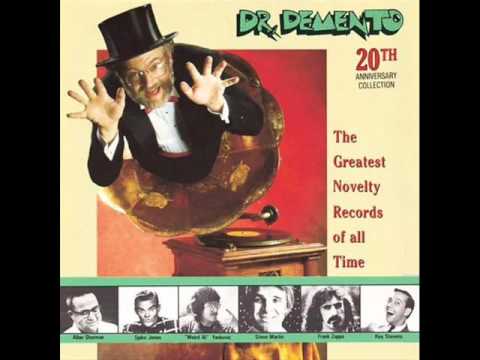
Larry Groce is a one-hit wonder, and he makes no bones about it. He's actually more of a country-music songwriter and radio host than an actual performing artist. He does alright though, recording the Disney series of Children's Favorites albums. But thanks to Dr. Demento, he will always be known to us as the "Junk Food Junkie" man.
Background: in 1976, the whole United States went health-food crazy. It was yogurt and wheat germ and brown sugar and carob-coated sunflower seeds as far as the eye could see. You can see where this is coming from when you look at the history: The Baby Boomer generation (born in the 1940s) were just hitting their 30s and 40s, when it's time to quit partying and start jogging if you want to live much longer. By the way, the whole country also went on a jogging kick, too. Anyway, health food stores popped up like mushrooms at a Grateful Dead concert. Just like the 2000s saw a boom in "green" merchandising, the manufacturers of the 1970s immediately saw that they weren't going to sell anything unless it was labeled "health food," and more likely than not "100% natural."
Of course the trend was exploited after awhile, and it was this time that Larry Groce chose to lampoon. It would be a shame to let the casual web visitor drop by and not fully appreciate the brilliant satire of this novelty hit single, so we're going to get unusually geeky this time. Let's break the lyrics down one reference at a time, for the historical preservation of it and so modern audiences don't miss anything:
"Junkie" was of course slang for a drug addict, who leads a double life trying to dodge the law and still keep their drug habit. The point of the song is one of being secretly addicted to junk food while still appearing to one's peers to be a health nut.
"Mr. Natural" is also a reference to hippie icon and underground cartoonist Robert Crumb and his white-bearded character "Mr. Natural" (you might have seen the 'Keep On Truckin' cartoon? That guy!).
"Macrobiotic trips": Well, there were no real 'trips,' but 'macrobiotic' was a popular health food store buzzword. It would be the kind of thing you'd want in a grain or legume, thoroughly pulverized and processed so your lentil puree went down like a smoothie. Stay near a bathroom, because it's going to be a short trip through you.
"Whole Earth Vitamin Bar": There was no such place, but there were many places just like what you'd expect; think the precursor to the modern-day juice bar. "Whole Earth" is another reference to the Whole Earth Catalog, another sacred hippie relic.
"Commune" and "arts and crafts": Group-home living and alternative lifestyles (i.e. swingers and 'open marriages') were a common practice, usually trying to fashion themselves after the free-love communal living described in Robert A. Heinlein's novel Stranger In a Strange Land but ending up more in the Eldritch drug-hallucinating nightmare described in Harlan Ellison's short story Shattered Like a Glass Goblin instead. Incidentally, many of this age also tried to support themselves with arts-and-crafts. The macrame owls (their glass eyes will watch forever in our nightmares), wicker furniture, and velvet paintings you see in thrift stores today are the remnants of this movement.
Euell Gibbons was a famous rustic-living and natural-diet guru who wrote lots of books on the subject, with titles like Stalking the Wild Asparagus, Beachcomber's Handbook, and Feast on a Diabetic Diet.
John Keats didn't have anything to do with health nuts that we know of... this is the poet John Keats, who wrote Ode on a Grecian Urn. So, yeah, Greek art was in style too, and this bit of hyperbole merely states how dedicated he is to keeping brown rice handy.
The various junk foods, of course, need no introduction, being very much present today in the same forms and mostly same names. Meanwhile, the bran muffins are a mercifully-distant memory. This is as it should be, because as anybody who lived in the '70s can tell you, all the food tasted exactly like you were eating the dried-out clippings after mowing the lawn. Moo!