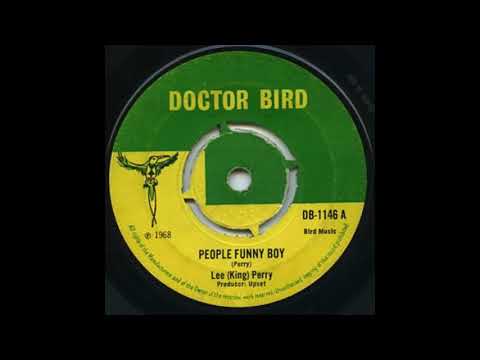
People Funny Boy

Album: People Funny Boy Various Artists (1968)
Play Video

Songfacts®:

  • Jamaican musician Lee "Scratch" Perry's musical career began in the late 1950s as a record seller for Clement Coxsone Dodd's sound system. After he recorded nearly 30 songs for the label, the pair fell out and Perry found a new home at Joe Gibbs' Amalgamated Records. Perry continued his recording career but, once again, financial problems caused conflict. After splitting with Gibbs he formed his own label, Upsetter, in 1968 and released this song as his first single. The tune was a scathing attack directed at Gibbs and it heralded a new era in Jamaican music. Though not the first reggae song to be released (musicologists often cite Larry Marshall's "Nanny Goat," from a few months earlier, as the original), this song sounded like no other record made. Featuring a fast, chuggy beat, it had an intrinsic Jamaican feel that eschewed the American soul stylings of the prevalent rock steady sound.
  • The song is also notable for its innovative use of a sample, in this case a crying baby. Perry explained in Q Magazine's 100 Songs That Changed The World how the cries coming from a Pocomania church, (an African-based religion similar to voodoo) was the inspiration. He said: "One night me walking past a Pocomania church and hear the people inside a wail. And me catch the vibration and say boy! Let's make a sound fe catch the vibration of them people!"
  • The song proved a huge hit for Perry in Jamaica and laid the foundation for him becoming the most in-demand producer in Jamaica until he suffered a breakdown in 1978. The music that The Wailers made with Perry between 1969 and 1971 and his production for such notable musicians such as Junior Murvin, The Congos and Max Romeo had everyone from Paul McCartney to Robert Palmer beating a path to his door. Perry now lives in Switzerland and continues recording and performing to enthusiastic audiences in Europe and North America.
  • Perry told the story of the song to Mojo magazine June 2010: "Me did have a friend named Andy Capp, him was working down by West Indies studio as an engineer, and me and him used to drink rum together at that time, and we share thoughts. Somewhere along the line we decided to make a song together, and we make 'People Funny Boy'; him used to do the radio jingles, and him have a record with a baby crying, so he want me to hear it, and when we listen to it, it's exactly like whilst we were talking about in the song, 'cos we was hungry, didn't have no food a yard, and the baby need food. So we used the baby crying in the song 'cos it matched with what goes on. It was a foreign recording, Andy was a jingle collector, so when me hear it, me say, 'It's really too serious, it's all about the song we're singing here now, ' funny people, and kids who are crying who don't have nothing."
  • Perry explained to Mojo the inspiration behind the rhythm, which some claim made it the first reggae record: "People who deal with spiritual vibration, like me, the spirit tell me exactly what to do, what instrument to use and how to play the bass line, so you tell the musicians exactly what you're hearing; when me hear it from the spirit world, me just tell the musicians what me hear, and it works. So that makes things very easy, when you're communicating with spiritual vibrations."

Comments

Be the first to comment...

Editor's Picks

Johnette Napolitano of Concrete Blonde

Johnette Napolitano of Concrete BlondeSongwriter Interviews

The singer/bassist for Concrete Blonde talks about how her songs come from clairvoyance, and takes us through the making of their hit "Joey."

How "A Rolling Stone Gathers No Moss" Became Rock's Top Proverb

How "A Rolling Stone Gathers No Moss" Became Rock's Top ProverbSong Writing

How a country weeper and a blues number made "rolling stone" the most popular phrase in rock.

Jay, Peaches, Spinderella and other Darrining Victims

Jay, Peaches, Spinderella and other Darrining VictimsSong Writing

Just like Darrin was replaced on Bewitched, groups have swapped out original members, hoping we wouldn't notice.

Eric Clapton

Eric ClaptonFact or Fiction

Did Eric Clapton really write "Cocaine" while on cocaine? This question and more in the Clapton edition of Fact or Fiction.

Michael Glabicki of Rusted Root

Michael Glabicki of Rusted RootSongwriter Interviews

Michael tells the story of "Send Me On My Way," and explains why some of the words in the song don't have a literal meaning.

Glen Burtnik

Glen BurtnikSongwriter Interviews

On Glen's résumé: hit songwriter, Facebook dominator, and member of Styx.