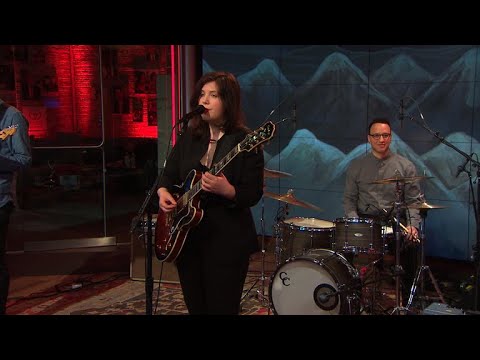
Pillar Of Truth

Album: Historian (2018)
Play Video

Songfacts®:

  • On her album Historian's previous track, "Next Of Kin," Lucy Dacus sings about the inevitability of her own death, but "Pillar Of Truth" is about the loss that gave her the peace to accept it.

    "It's about watching my grandma die," Dacus explained in a 2018 track-by-track interview with Newsweek. "Which was an actually good experience. I learned a lot from her. And she approached her death with such grace and contentment and calm. She planned her own funeral. She picked the hymns that would be played. She found new piano teachers for her piano students."

    Despite wrenching lyrics like, "I'm weak looking at you, a pillar of truth, turning to dust," Dacus thinks the song is a hopeful one, because its inspiration gave her the courage to face one of her biggest fears. "I think the biggest lesson she ever taught me was how to die," she continued. "When people think about the ideal of death, she came really close to what people wish for themselves. So the song has a lot of her in it. There are a lot of biblical references. A lot of hymn references. We got the horns in there because the horns reminded me of, like, an angel choir. A brass band from heaven, welcoming her."
  • In the third verse, Dacus sings, "Lord, have mercy on my descendants, for they know not what they do." This is a reference to Jesus' prayer for God to show mercy to his persecutors during his crucifixion in Luke 23:33-34: "Father, forgive them, for they know not what they do."
  • The third verse also points to an old superstition that claims sparrows are harbingers of death if they die by flying into a closed window.

    Lord, prepare me
    For the shadows
    For the sparrows
    At my window


    On the other hand, sparrows are used as an example in the Bible of God's care and provision for even the humblest of creatures, with Matthew 10:29 stating, "Are not two sparrows sold for a penny? And not one of them will fall to the ground apart from your Father. And even the very hairs of your head are all numbered. So don't be afraid - you are worth more than many sparrows." The passage also inspired the popular hymn "His Eye Is On The Sparrow."
  • In the fifth verse, Dacus inverts the lyrics to "Amazing Grace." While the hymn's words reflect a conversion experience that metaphorically opens the eyes of the author ("I once was lost but now I'm found, was blind but now I see"), it's now the prayer of a believer who is losing her faculties near death:

    Lord, be near me
    My final hour
    I once had sight
    But now I'm blind
  • Despite the biblical themes in the song, Dacus, who was raised in a Christian household, is no longer religious. "I used to cling to 'Christian agnostic,' but I've dropped that," the singer told Rolling Stone in 2021. Her loss of faith inspired another Historian track: "Nonbeliever."
  • This was used in the TV series 13 Reasons Why in the season 2 episode "The Second Polaroid" (2018). It plays during a scene when Alex and Jessica talk on the beach after skipping school.

Comments

Be the first to comment...

Editor's Picks

Gilby Clarke

Gilby ClarkeSongwriter Interviews

The Guns N' Roses rhythm guitarist in the early '90s, Gilby talks about the band's implosion and the side projects it spawned.

Ron and Russell Mael of Sparks

Ron and Russell Mael of SparksSongwriter Interviews

The men of Sparks on their album Hippopotamus, and how Morrissey handled it when they suggested he lighten up.

Sam Hollander

Sam HollanderSongwriter Interviews

The hitmaking songwriter/producer Sam Hollander with stories about songs for Weezer, Panic! At The Disco, Train, Pentatonix, and Fitz And The Tantrums.

Dave Edmunds

Dave EdmundsSongwriter Interviews

A renowned guitarist and rock revivalist, Dave took "I Hear You Knocking" to the top of the UK charts and was the first to record Elvis Costello's "Girls Talk."

Church Lyrics

Church LyricsMusic Quiz

Here is the church, here is the steeple - see if you can identify these lyrics that reference church.

Martin Page

Martin PageSongwriter Interviews

With Bernie Taupin, Martin co-wrote the #1 hits "We Built This City" and "These Dreams." After writing the Pretty Woman song for Go West, he had his own hit with "In the House of Stone and Light."