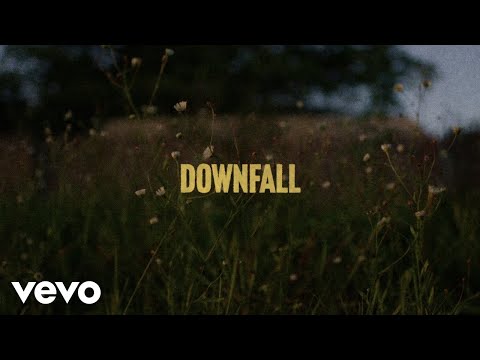
Downfall

Album: The Great Divide (2026)
Charted: 23
Play Video

Songfacts®:

  • "Downfall" is about a very specific emotional contradiction: missing someone before they have even left, feeling relieved they are gone, and simultaneously hoping their new life collapses badly enough that they have no choice but to come back.
  • What makes the song unusual in the breakup canon is that Noah Kahan is not trying to come out ahead. In the chorus, when he sings, "I don't mind being your dead end," he is effectively rooting for mutual failure. The relationship survives not through healing or growth, but through exhaustion; two people repeatedly circling back because nowhere else works. His promise to leave the house untouched, and his image of keeping an ear pressed to the doorframe waiting for her return, portray a devotion that has curdled into emotional paralysis.
  • The second verse gets even darker. Kahan is no longer merely waiting for her return; he is actively hoping her fresh start proves underwhelming:

    I'm hoping that the view ain't nice, that the streetlights bleed into your bedroom
    That you open up to someone kind, and they hold it all against you


    It is an extraordinarily harsh sentiment, but the song's power lies in the fact that it does not feel spiteful. Kahan is not wishing for her downfall simply to hurt her; he is wishing for it because failure is the only path he can imagine leading her home again. The title sounds bitter, but the emotion underneath is strangely romantic, or at least romantically self-destructive. That tension is where the song lives.
  • The track feels like a spiritual cousin to "All My Love" from Stick Season, another song built around a relationship trapped in cycles of departure and return. But where "All My Love" still carries warmth and nostalgia, "Downfall" is its darker mirror image. Kahan no longer treats the pattern as poetic; he recognizes it clearly and prepares for it anyway.
  • Noah Kahan recorded "Downfall" for his fourth album, The Great Divide. He wrote the song with his two producers, Aaron Dessner and Gabe Simon, during a session at Aaron Dessner's Long Pond Studio in upstate New York.

    The mood during The Great Divide's creation oscillated dramatically depending on where they were in the process. "Early on, it was angry and dark, Simon told Billboard. "I remember heading up to Long Pond with Noah, and he goes, 'I just want to write dark, angry s--t.' And I was just like, 'Let's do it.' That's when we did 'Downfall' and 'Lighthouse' and 'A Few of Your Own,' which is not sad or angry at all."

    "Downfall" is the purest product of that dark energy, a breakup song that dispenses with sadness entirely and goes straight to something more uncomfortably honest.
  • Justin Vernon of Bon Iver contributed background vocals and banjo to the track. Vernon and Dessner have been close collaborators since the late 2000s, when Dessner sent Vernon an instrumental sketch that eventually evolved into their long-running project Big Red Machine.
  • Positioned at track 4 - early in the album but after the scene-setting of "End Of August," the emotional complexity of "Doors" and the family emergency of "American Cars" - "Downfall" establishes that The Great Divide will not flinch from the uglier corners of romantic feeling. It is the album's most openly vitriolic love song, signaling that Kahan is not interested in easy emotional resolution this time around. The bugs that don't die and the spring that looks like autumn in the second verse tie the song back to the album's seasonal motifs, here deployed not as nostalgia but as a curse.
  • "Downfall" presents an interpretive puzzle that the timeline of Kahan's life makes particularly interesting. Written during what producer Gabe Simon described as an early, "angry and dark" phase of recording at Aaron Dessner's Long Pond Studio, likely 2024, well before Kahan married his longtime partner Brenna Nolan in August 2025, the song's revolving-door romantic dynamic sits uneasily with the picture of a man in a settled, long-term relationship heading toward marriage. The most straightforward reading, that it draws on older, pre-Brenna emotional territory, is plausible: much of Kahan's catalog documents the unstable romantic landscape of his earlier adult life, and the Long Pond sessions were explicitly designed to excavate dark feelings rather than reflect his present circumstances.

    But Holler offers a more provocative alternative: that "Downfall" is not a romantic song at all, but Kahan inhabiting the voice of the friends and community left behind in Strafford, Vermont, rooting, half-consciously, for his career to collapse so he comes home. On this reading, "I don't mind being your dead end" is not a lover's resignation but a hometown's quiet expectation; the Garden State and California imagery represents the pull of fame rather than a former girlfriend; and "I'll keep rooting for your downfall" becomes the most honest thing anyone back home has ever admitted to feeling. That reading aligns with the album's broader, unresolved guilt about leaving, and makes "Downfall" one of The Great Divide's most quietly devastating tracks, regardless of which interpretation you accept.
  • Kahan performed "Downfall" live with Hayley Williams at Ryman Auditorium on April 28, 2026, the night after the album's release.

Comments

Be the first to comment...

Editor's Picks

Jimmy Jam

Jimmy JamSongwriter Interviews

The powerhouse producer behind Janet Jackson's hits talks about his Boyz II Men ballads and regrouping The Time.

Top American Idol Moments: Songs And Scandals

Top American Idol Moments: Songs And ScandalsSong Writing

Surprise exits, a catfight and some very memorable performances make our list of the most memorable Idol moments.

Amanda Palmer

Amanda PalmerSongwriter Interviews

Call us crazy, but we like it when an artist comes around who doesn't mesh with the status quo.

Jon Anderson

Jon AndersonSongwriter Interviews

Jon Anderson breaks down the Yes classic "Seen All Good People" and talks about his 1000 Hands album, which features Chick Corea, Rick Derringer, Ian Anderson, and many other luminaries.

Andy McClusky of OMD

Andy McClusky of OMDSongwriter Interviews

Known in America for the hit "If You Leave," OMD is a huge influence on modern electronic music.

Jon Anderson of Yes

Jon Anderson of YesSongwriter Interviews

From the lake in "Roundabout" to Sister Bluebird in "Starship Trooper," Jon Anderson talks about how nature and spirituality play into his lyrics for Yes.