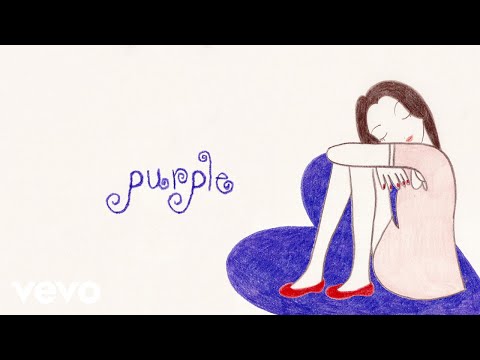
Purple

Album: You Seem Pretty Sad for a Girl So in Love (2026)
Charted: 25
Play Video

Songfacts®:

  • "Purple" finds Olivia Rodrigo exploring what happens when a relationship becomes so close that the people inside it begin to blur together. The song starts in the euphoric phase of romance, when two distinct personalities merge into something new:

    And I melt with you, your red and my blue
    Now I see the world in purple


    In color theory, red and blue combine to create purple. As a secondary color born from separate hues, it represents the merging of two distinct personalities into something entirely new and beautiful.
  • As the song progresses, the colors stop complementing each other and begin cancelling each other out. What first felt like intimacy starts to resemble erasure. Rodrigo flips the metaphor in the closing lines:

    Melt with you 'til it all turns black
    When you smooth it out, but it feels too flat


    Mix enough colors together and you eventually lose the distinctions that made them interesting in the first place. It's a phenomenon familiar to painters and, unfortunately, to couples who discover that becoming one person is less romantic than the brochures suggested.
  • Rodrigo's use of color to describe personality and emotional states places her in a tradition of pop songwriters who use the visual spectrum as an emotional shorthand. Taylor Swift has used color throughout her career with similar intent: "Red" (2012) uses the color to evoke the chaotic intensity of a doomed relationship ("Loving him was red"), while "Lavender Haze" from Midnights (2022) deploys a specific color to describe the dreamy, all-encompassing bubble of new love.

    Rodrigo's purple occupies a space between those ideas: the intoxicating stage where two people become inseparable, followed by the unsettling realization that inseparable and indistinguishable are not quite the same thing.
  • Rodrigo originally wrote "Purple" with producer Daniel Nigro and songwriter Amy Allen as a straightforward love song. Months later, after working on darker material for the album, she and Nigro revisited it.

    "Dan and I, after writing breakup songs and stuff, we had the fun challenge of going back and actually tweaking some of the love songs that are on the record and making them a little more honest and more sad and creepy," Rodrigo told The New York Times Popcast. "I was really happy with the way it turned out... We kind of like, postmortem, we went in and changed things and made it a whole body of work rather than, you know, like little moments."

    The revisions transformed "Purple" from a simple romantic snapshot into something far more complicated.
  • You Seem Pretty Sad for a Girl So in Love captures the rise and fall of a romantic relationship. Placed as Track 7, the final song on Side 1 of the album, "Purple" is the album's turning point, observing the exact moment doubt creeps into the relationship. Up to this point, the record mostly basks in the glow of infatuation; after "Purple," the emotional weather begins to change. It isn't a breakup song, but rather the first crack in the windshield, small enough to ignore at first, but impossible to unsee once it's there.
  • Rodrigo wrote the song while she was in a relationship with English actor Louis Partridge, and revised it after the relationship ended. In that sense, the song's evolution mirrors the story it tells. What began as a bright, uncomplicated blend of colors was updated with hindsight, darkened at the edges, and given a more complicated shade.

    "Initially, it was a love song, and it was very sweet and saccharine," Rodrigo told the BBC. "A few months after we wrote it, we revisited it and put new chords underneath it and tweaked some of the lyrics."

Comments

Be the first to comment...

Editor's Picks

The Untold Story Of Fiona Apple's Extraordinary Machine

The Untold Story Of Fiona Apple's Extraordinary MachineSong Writing

Fiona's highly-anticipated third album almost didn't make it. Here's how it finally came together after two years and a leak.

Lace the Music: How LSD Changed Popular Music

Lace the Music: How LSD Changed Popular MusicSong Writing

Starting in Virginia City, Nevada and rippling out to the Haight-Ashbury, LSD reshaped popular music.

Justin Hayward of The Moody Blues

Justin Hayward of The Moody BluesSongwriter Interviews

Justin wrote the classic "Nights In White Satin," but his fondest musical memories are from a different decade.

Phone Booth Songs

Phone Booth SongsSong Writing

Phone booths are nearly extinct, but they provided storylines for some of the most profound songs of the pre-cell phone era.

Part of Their World: The Stories and Songs of 13 Disney Princesses

Part of Their World: The Stories and Songs of 13 Disney PrincessesSong Writing

From "Some Day My Prince Will Come" to "Let It Go" - how Disney princess songs (and the women who sing them) have evolved.

Adele

AdeleFact or Fiction

Despite her reticent personality, Adele's life and music are filled with intrigue. See if you can spot the true tales.