This song shows Morrissey's unhappiness with the British monarchy. He makes reference to the Queen with her head in a sling. It's not quite as vengeful as "
God Save The Queen," but still a scathing attack on the royals.
Morrissey explained to
NME in 1986: "I didn't want to attack the monarchy in a sort of beer monster way but I find as time goes by this happiness we had slowly slips away and is replaced by something that is wholly grey and wholly saddening. The very idea of the monarchy and the Queen of England is being reinforced and made to seem more useful than it really is. The whole things seems like a joke. A hideous joke."
In the line "So I checked in the historical facts, and I was shocked into discover, I was the 18th pale decedent of some old queen or other," Queen is also an old English word for homosexual.
>>>
Suggestion credit:
Cillian - Cork, Ireland, for above 2
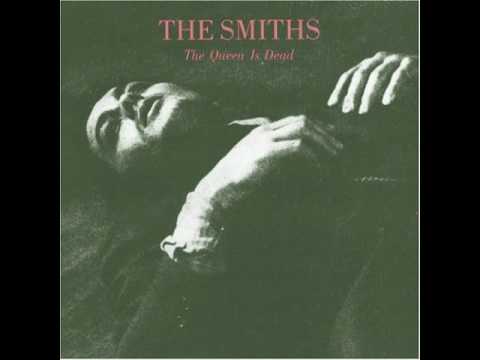
The album's cover image was designed by Morrissey himself and features French actor Alain Delon from the 1964 film L'Insoumis.
The music for this song emerged from a pounding 13-minute jam session with Marr capturing accidental feedback from his wah-wah pedal. "I held my breath for 10 minutes while I was doing it," he recalled to NME June 18, 2011. "Conceptually I was trying to do that Detroit thing, the MC5 and garage rock and I just got it wrong - but if you're lucky that stuff comes out sounding like yourself anyway."
The sample that opens the song features music hall veteran Cicely Courtneidge singing the World War I standard "
Take Me Back To Dear Old Blighty," in Bryan Forbes' 1962 British film
The L-Shaped Room.
The album title was taken from a section of American author Hubert Selby's 1964 novel, Last Exit To Brooklyn, which caused much controversy due to its frank portrayals of rape, drug use, homosexuality, transvestism and domestic violence.
At one point Morrissey sings, "That's nothing - you should hear me play piano." We got that chance on The Smiths next album Strangeways, Here We Come when Morrissey played piano on the song "Death of a Disco Dancer."
This song, "
Panic" and "
There Is A Light That Never Goes Out" formed part of a 13-minute short film, directed by the avant-garde filmmaker, Derek Jarman, in 1986.
The Queen Is Dead, which compromises of evocative, nightmarish and fast-paced collages of urban decay, is available to view on
YouTube.
Bassist Andy Rourke recalled the recording of the song to Mojo magazine: "When it started it was a schizophrenic kind of funky, punky instrumental that didn't really go anywhere. I think on the day we recorded it, Johnny had just got a new wah wah pedal so he was kind of putting it through its paces and we went back to this old rift with a different approach. Mike struck up this great drum beat and... it just kind of happened. Johnny's said it one of the best bass lines ever, and it is pretty good. I was dictating, in my most polite way, the groove."
Richard Heslop directed
13-minute video, which was his first paid job after graduating from Saint Martin's film school. Derek Jarman had seen Heslop's work with the post-punk band 23 Skidoo and, having been commissioned to make three videos for The Smiths, asked him if he would like to direct one.
Heslop chose "The Queen Is Dead" because he liked the way it combines punk energy with something more expansive. "It had the drive of punk and tipped into a beautiful rollercoaster of layered energy," he told
Uncut magazine.
The video was shot at the old Beckton Gas Works in East London. Heslop's girlfriend at the time, Francesca, plays the main character, spinning through the ruins of industrial England. The location later became even more famous when Stanley Kubrick used it as a setting for Full Metal Jacket.
Heslop described the song as "a beautiful cut-up of ingredients" that builds into a "whirling dervish of sound," and the video reflects that restless energy.
Heslop went on to shoot videos for the likes of Happy Mondays and New Order, as well as direct programs on Channel 4 and the BBC.
Some time later, Heslop bumped into Morrissey at a motorway service station and told him that he had made the video. He wasn't sure Morrissey believed him.