Crawling Back To You

Album: Wildflowers (1994)
Play Video

Songfacts®:

  • "Crawling Back to You," positioned as the penultimate track on Tom Petty's 1994 Wildflowers album, stands as one of his most emotionally vulnerable and deeply personal compositions. The song has become a fan favorite and deep-cut classic, praised for its haunting melody, sparse production, and lyrics that capture the painful pattern of leaving and returning.
  • Petty had always been fond of characters who drift, bolt, or quietly unravel; see the narrator of "Free Fallin'" who glides through Los Angeles on charm and vague regret, or the restless romantic in "You Don't Know How It Feels" spinning freedom like it's both cure and curse. But "Crawling Back to You" strips away the California sunshine and cool-guy bravado. Here, the escape fantasy collapses. The open road turns into a cul-de-sac, and instead of roaring back like the defiant figure in "Runnin' Down A Dream," the narrator returns humbled, bruised, and very possibly covered in metaphorical barroom dust.
  • The song's meaning is deliberately slippery. Petty hands you just enough emotional furniture to recognize the room but leaves you to decide what happened there. One widely shared interpretation frames the song as an unflinching portrait of anxiety and depression, which is supported by the bridge:

    I'm so tired of being tired
    Sure as night will follow day
    Most things I worry about
    Never happen anyway


    The bridge lyric, one of Petty's most quoted and beloved couplets, manage to put words to the exact feeling of an anxiety-ridden mind.
  • The phrase "crawling back" implies friction, shame, and an acute awareness that you are not making your most dignified entrance. Petty is caught in a cycle of self-sabotage - dirty hands, worn-out knees, and the lingering suggestion of ill-advised altercations - before returning to a source of comfort, forgiveness, or possibly just familiar heartbreak.

    Within the context of Petty's life during the Wildflowers sessions, the song clearly reflects his crumbling marriage to Jane Benyo. Petty clarified in Paul Zollo's book Conversations with Tom Petty: "I've heard Echo is the divorce album, but Wildflowers is the divorce album. That's me preparing to leave."

    "Crawling Back to You" captures the push-pull dynamic of a relationship in its death throes: the desire to escape versus the pull to return to something familiar.
  • Another interpretation hears "Crawling Back to You" as an addiction narrative, with the "you" representing a destructive dependency rather than a person. This reading gained retrospective weight following Petty's documented heroin struggles later in the 1990s.
  • The song carries personal resonance for Heartbreakers drummer Steve Ferrone. "When I started with the Heartbreakers, I was approaching the end of my drinking career," he told Uncut magazine. "I got sober on April 30, 1993, and that beautiful line from 'Crawling Back To You,' 'Most things I worry about never happen anyway,' really stuck with me. When Tom passed I had it tattooed on my left arm with a little Heartbreaker logo that points at my heart whenever I sit and play. That line means a lot to somebody in recovery like me, who's worried about everything."
  • Petty holds the sole songwriting credit, but the recording thrives on the understated chemistry of the Wildflowers ensemble. Produced by Petty, his guitarist Mike Campbell and producer Rick Rubin, the arrangement is restrained. Benmont Tench's haunting piano drifts through the track, while Campbell contributes understated guitar. The song repeatedly threatens to build momentum before pulling back, mirroring a narrator who can neither fully leave nor decisively stay.

    Capturing that fragile balance in the studio proved unusually difficult. Petty recalled to Paul Zollo that after an entire night of unsuccessful attempts, they decided to play the song as though encountering it for the first time, allowing spontaneity to guide the performance. The resulting take, built from Petty casually starting to play while the band gradually joined, delivered the loose yet emotionally precise feel that defines the finished recording. "That's the value of a live group in the studio," said Petty. "I'd have never come up with that without them."
  • Unlike several of Wildflowers' marquee tracks, "Crawling Back To You" was never released as a commercial single and didn't receive an official music video during the album's original rollout, which focused on more radio-friendly offerings like "You Don't Know How It Feels," "You Wreck Me," and "It's Good to Be King." The song instead developed a reputation as buried treasure, the kind of track fans discover late at night and then evangelize about with missionary zeal.

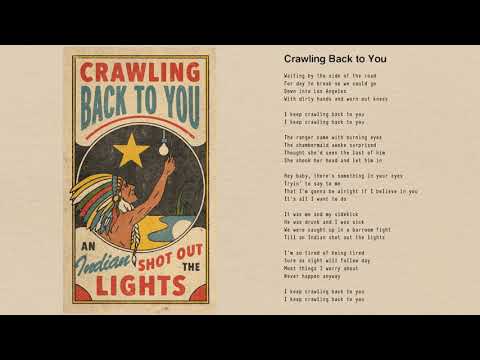
    The Petty estate later helped introduce the song to newer audiences with an official lyric video released on October 15, 2020, during promotion for the expanded Wildflowers & All the Rest box set. A rehearsal video from the 1995 Dogs With Wings tour followed in September 2024, directed by Justin Kreutzmann and assembled from archival footage shot by Martyn Atkins, offering a rare glimpse of the Heartbreakers working through the song in its natural habitat: the rehearsal room.
  • Live performances of "Crawling Back to You" have been surprisingly scarce, which only enhanced its mystique. The song debuted in 1993 during the opening of Johnny Depp's Viper Room, an appearance briefly glimpsed in the documentary Runnin' Down a Dream, and surfaced once more during the 1995 Dogs With Wings tour before vanishing from setlists for years. It reemerged in 2003 during a series of intimate Chicago shows, including a PBS Soundstage performance. Encouraged by the response, the Heartbreakers incorporated the song more regularly into their 2005 tour.
  • Sequenced as track 14 of the original 15-song Wildflowers album, "Crawling Back to You" plays a crucial role in the record's emotional trajectory. Following the loose swing of "Cabin Down Below" and the reflective storytelling of "To Find A Friend" and "A Higher Place," the song returns the album to its central themes: vulnerability, the cyclical nature of departure and return, and the uneasy realization that independence sometimes arrives wrapped in loneliness. It serves as the final emotional reckoning before "Wake Up Time" closes the album with a tentative sense of renewal, less a victory lap than the quiet sunrise that follows a long, introspective night.

Comments

Be the first to comment...

Editor's Picks

Donnie Iris (Ah! Leah!, The Rapper)

Donnie Iris (Ah! Leah!, The Rapper)Songwriter Interviews

Before "Rap" was a form of music, it was something guys did to pick up girls in nightclubs. Donnie talks about "The Rapper" and reveals the identity of Leah.

Bass Player Scott Edwards

Bass Player Scott EdwardsSong Writing

Scott was Stevie Wonder's bass player before becoming a top session player. Hits he played on include "I Will Survive," "Being With You" and "Sara Smile."

Chris Fehn of Slipknot

Chris Fehn of SlipknotSongwriter Interviews

A drummer for one of the most successful metal bands of the last decade, Chris talks about what it's like writing and performing with Slipknot. Metal-neck is a factor.

Carol Kaye

Carol KayeSongwriter Interviews

A top session musician, Carol played on hundreds of hits by The Beach Boys, The Monkees, Frank Sinatra and many others.

James Bond Theme Songs

James Bond Theme SongsMusic Quiz

How well do you know the 007 theme songs?

Annie Haslam of Renaissance

Annie Haslam of RenaissanceSongwriter Interviews

The 5-octave voice of the classical rock band Renaissance, Annie is big on creative expression. In this talk, she covers Roy Wood, the history of the band, and where all the money went in the '70s.