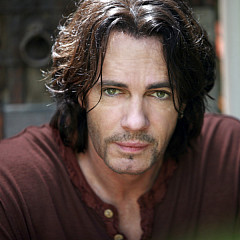
 In his 20-year recording career, Josh Rouse has never been afraid to explore new musical territory. The Nebraska-born singer-songwriter has traveled with an indie folk tag since his acclaimed 1998 debut, Dressed Up Like Nebraska. He's visited '70s-era Southern California with 1972, Tennessee's country music capital with Nashville, and the streets of Spain, where he relocated in 2006, with El Turista.
 Rouse's wanderlust called him back to the '80s with his latest album, Love In The Modern Age. The upbeat assortment of synthesized pop tunes was inspired by Rouse's high school record collection, including early albums from UK acts The Blue Nile, The Style Council, Prefab Sprout, and Roxy Music, as well as Leonard Cohen's post-acoustic records Various Positions and I'm Your Man.
Leading up to the album's release (April 13, 2018), Rouse gave Songfacts a glimpse behind the scenes of Love In The Modern Age.
Josh Rouse: I have made a playlist on Spotify. Most everything from the '80s on that list was an influence.
Songfacts: The album is quite a departure from your earlier work. What was the biggest challenge in making the album and how did you overcome it?
Rouse: It's very different sonically from the last decade of work I've put out but it does share some harmonic genes with my first two records which were more British influenced. The biggest challenge was and always is making it simple and minimalistic and enjoyable!
Songfacts: You've cited Leonard Cohen as a major influence. What is it about his work that you admire?
Rouse: The storytelling. How he brings you into the song with the first line. There are lots of great vocalists out there but few have the ability to grab your attention with just the lyric and not some fancy vocal move.
Songfacts: Cohen said he had to labor a long time over his song "I'm Your Man." Was the same true of your "I'm Your Man"?
Rouse: No, my song was quick, almost as if Jimmy Reed had wrote it! There were other songs I worked on a lot more.
Songfacts: What does Daniel Tashian bring to the table as a co-writer? Do you prefer writing songs with others?
Rouse: I have worked with Daniel as a writer since 2004. Before that, he played guitar in my touring band so we share a love of major seven chords. We've written some of my most popular songs together. I think he knows what I like and how to make that more commercial so it reaches a wider audience. Pop instinct is what he brings.
Songfacts: How has your approach to songwriting changed over the years?
Rouse: For this record I wrote to tracks and grooves with just a title in mind. Not too much guitar. Lyrics are hard to finish and finding the right sentiment is difficult for me so I don't write as often as I should.
Songfacts: At what point do you know a song is finished?
RouseI usually demo it in some form and if it feels satisfying I say it's done.
Songfacts: At Songfacts, we look at the stories behind the songs. What was the inspiration for the title track, "Love In The Modern Age"?
Songfacts: Is the "Businessman" a representation of the touring musician?
Rouse: It could be, or an investment baker. Everything is business nowadays, innit?
Songfacts: Were there really a Georgie and Melissa from "Ordinary People, Ordinary Lives"?
Rouse: No, our apartment in Valencia faces the interior and I can see into about 200 other apartments. I play a voyeur/detective in this role.
Songfacts: With 1972, you evoked '70s-era Southern California and Nashville was inspired by that city. Where do you imagine this album could take place?
Rouse: I would have to say "Salton Sea" takes place there and "Ordinary People" in Valencia and a suburb of Chicago. "Love In The Modern" age is definitely New York City and "Businessman" is Paris and Japan. It's a globe trotter.
Songfacts: What song from the album are you the most proud of and why?
Rouse: If one of the songs becomes known worldwide I will most proud of that one. It's very difficult to get a melody and lyric across to the general public. At least for me and I've been trying for 20 years. Maybe I can answer this in a year?
Songfacts: Finally, as a performer who has worked in the music industry for years, what advice do you wish someone would have given you when you first started out?
Rouse: Write more songs and get a producer with good ideas. Try to find some famous friends whose music you like and they like yours. I never did that!
April 11, 2017
More Song Writing