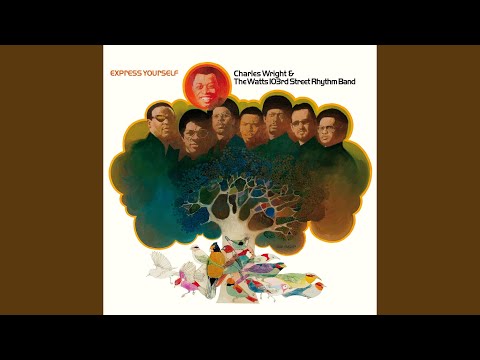
Album: Express Yourself (1970)
Charted: 12
Play Video

Songfacts®:

  • "Express Yourself" is the signature song of Charles Wright & the Watts 103rd Street Rhythm Band. It's about individuality and being true to yourself no matter what anyone else says. As Wright's website puts it: "'Express Yourself' in all that you say and do, regardless of what others think, as long as you do not hurt or offend anyone."
  • "Express Yourself" has been covered by multiple artists, including Kurtis Blow on his 1988 album Back by Popular Demand. The most notable cover for modern listeners is the 1988 N.W.A. song "Express Yourself," which isn't an exact remake but distinctly samples the original's chorus. N.W.A. included it on their debut album, Straight Outta Compton, and released it as a single in 1989. Their version hit #30 on the R&B chart and #50 on the UK Singles chart.

    During a 1995 Grand Royal interview titled Charles Wright Expresses Himself, journalist RJ Smith asked Wright about the N.W.A. version. Wright said, "Hate it! That song is so redundant. It's a very suggestive album in its own way, a very shocking album. But I couldn't listen to it but once, the music is so redundant."
  • In 1985, Wright rearranged the song to "Protect Yourself" for a performance at the first AIDS Walk Circle of Life Concert. It encouraged using condoms.
  • In 1971, the song was nominated for a Grammy Award for Best R&B Performance by a Duo or Group with Vocals. It lost to "Didn't I (Blow Your Mind This Time)" by The Delfonics.
  • "Express Yourself" wasn't a huge hit when it was first released, peaking at #12 in the US. It's one of those songs that stuck around, though, and is recognizable to listeners across generations, thanks to continual airplay, remakes and samples, and uses in media.
  • In 1993, Warner Archives released a Charles Wright & the Watts 103rd Street Rhythm Band greatest hits compilation titled Express Yourself.
  • Wright produced videos for a series titled Express Yourself, on which he interviews musicians and actors. Among them is a long interview with Little Richard.
  • "Express Yourself" has been sampled in many films, including Panther (1995 Mario Van Peebles film, not the Black Panther series), The People Vs. Larry Flint, Cheaper By The Dozen, The Little Fockers, and Mr. and Mrs. Smith.

    It's been used in commercials for Burger King, Kohl's, Kinko's, Singer, Nike, Tide Soap, Nokia, Bitburger Beer, Algida Ice Cream, the Professional Golfers' Association of America (PGA), and many others. In 2004, the NBA used it in their I Love This Game campaign.
  • In 2024, "Express Yourself" was featured in a commercial that ran during the Super Bowl starring Christopher Walken and Usher. It has Walken walking around town while all the common people he meets talk to him in his characteristic broken rhythm. He eventually happens across Usher, who's eating in the same restaurant as Walken.

Comments

Be the first to comment...

Editor's Picks

Verdine White of Earth, Wind & Fire

Verdine White of Earth, Wind & FireSongwriter Interviews

The longtime bassist of Earth, Wind & Fire discusses how his band came to do a holiday album, and offers insight into some of the greatest dance/soul tunes of all-time.

Thomas Dolby

Thomas DolbySongwriter Interviews

He wrote "She Blinded Me With Science" so he could direct a video about a home for deranged scientists.

Eric Burdon

Eric BurdonSongwriter Interviews

The renown rock singer talks about "The House of the Rising Sun" and "Don't Let Me Be Misunderstood."

Ed Roland of Collective Soul

Ed Roland of Collective SoulSongwriter Interviews

The stories behind "Shine," "December," "The World I Know" and other Collective Soul hits.

Ben Kowalewicz of Billy Talent

Ben Kowalewicz of Billy TalentSongwriter Interviews

The frontman for one of Canada's most well-known punk rock bands talks about his Eddie Vedder encounter, Billy Talent's new album, and the importance of rock and roll.

Harold Brown of War

Harold Brown of WarSongwriter Interviews

A founding member of the band War, Harold gives a first-person account of one of the most important periods in music history.