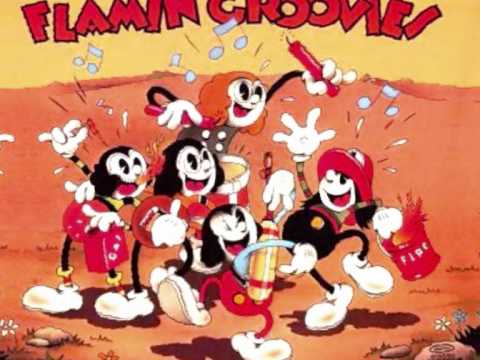
This delectable piece of power pop occupied a space between disco and punk, and was clearly influenced by '60 bands like The Beatles and The Who that Flamin' Groovies emulated. The San Francisco band Flamin' Groovies started in 1965, but didn't get much attention until they signed with Sire Records and released the Shake Some Action album, which met with critical adoration that may have been a little overblown - one reviewer said it would "trigger another rock & roll revolution, the inevitable backlash against disco for the dead."
Responding to the critical reaction and addressing the Beatles influence, Groovies lead singer Cyril Jordan said: "After years of trying to achieve an instrumental sound similar to the Beatles, we finally achieved it on Shake Some Action. And whether or not it was reviewed as a great thing or not, by then it didn't even matter. We know what we're doing. We know that when we cut something it's pretty damn near close in quality and originality to what we feel the Beatles achieved."
Flamin' Groovies first recorded "Shake Some Action" in 1972, but the song was not released until their 1976 album of the same name, which was produced by
Dave Edmunds, who made sure to speed up the tempo of the track and push the vocals. According to Cyril Jordan, the descending phrase he played on lead guitar was overdubbed about six times. Edmunds would also put remote microphones around the studio, to fatten up certain passages.
The Shake Some Action album and its follow-up, Flamin' Groovies Now, also produced by Edmunds, did reasonable well in England but suffered from a lack of promotion in America, as Sire Records became preoccupied with new signings Ramones and Talking Heads. For Americans who discovered the Flamin' Groovies, they remain a cult favorite.
In our 2013 interview with the band's vocalist and the song's co-writer Chris Wilson, he said his favorite cover of the track was by American Alternative rock band
Cracker, whose cover was featured in the 1995 teen movie
Clueless. He said, "Both me and Cyril [Jordan, his co-writer] made some money from that, a rare situation for the Groovies and a welcome one, too."
Wilson felt the songwriting process on this one was fairly easy: "Cyril had the idea for the music, I think. But the lyrics... we'd sit around Rockfield and swap lines and ideas. If we were in different parts of the house and we had an idea for a song we find each other and pick up a guitar. Back at the start we worked in a really simple way – swapping licks and phrases. 'Shake Some Action' really wasn't that difficult in that respect."
The interplay between the introspective, reflective verses and the "call to action" choruses structure the song as a journey to confidence and self determination. In the opening verse the singer's bravado is undercut by his confessions of fear of falling short in his love life and the second verse demonstrates the persona's spiritual anxiety (even going so far as to threaten the omnipotent). In the final verse, the singer seemingly follows the advice set out in the chorus and "shakes some action": I will go away and won't come this way again cause I don't need your praise."
The "you" being addressed here is likely the lover addressed in the opening verse, however it is made ambiguous by the continued motif of religious imagery "fall, Lord, praise." The song can justifiably be interpreted as a break up song, both in terms of love and religion.
There are several recorded versions of the track, as Wilson explained in our interview: "Dave added loads of effects to the guitars on the first attempt at "Shake Some Action," which we thought might have been a bit too much. That's why we cut a second version back in the US in 1973. In the end they're both good, albeit a little different – we're happy if people like the song. What more could we ask?"