Waiting For Amelia

Album: Gretchen Peters (2000)
Play Video

Songfacts®:

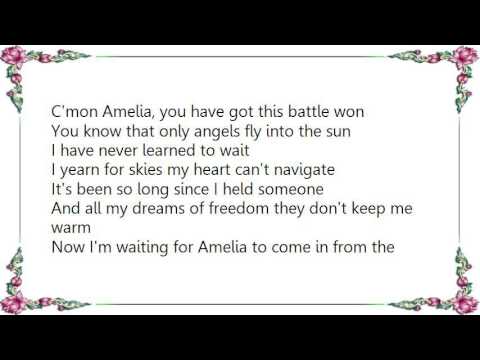
  • It was during a period of inward evaluation that Gretchen Peters wrote this song. Using Amelia Earhart as a metaphor, she explored the self-imposed boundaries that women have with regards to following their dreams. Peters explained to Songfacts, "Amelia is obviously a very romantic evocative figure, for obvious reasons. I mean, she disappeared, she was strong, she was beautiful, she did what she wanted to do. She was independent. She was a very interesting figure. The thing that interested me about her was that nobody knows what happened to her. Of course, we assume that she died. But the idea that this woman goes off doing this incredibly adventurous, independent thing that she does, and we don't know what became of her, means that we can't answer the story, we can't make easy platitudes about what that means for a woman to do that. We can't say, 'Well, she died because she wasn't experienced enough.' We don't know. We literally don't know. And I found that really, really irresistible. I guess for me, the metaphor of the song really was something I was trying to examine inside myself, which was to what end will you go to follow your own internal compass. How far will you go? How much risk will you take? And she just seemed to be the perfect metaphor for that. The part in the bridge, 'Maybe she lost her way, maybe she just didn't want to come home,' spoke a lot to me about a lot of women's predicaments or lives, that there may be a part of them that wants to fly and maybe not come home." And Peters knows many women who have wanted to do just that at some point in their lives. "So I guess as a woman, I really identified with that. Of course, the probability is Amelia died in bad weather and her plane went down. But maybe she just didn't want to come home. Maybe she really escaped. I just thought it was an irresistible, beautiful sort of thought. And emblematic of what a lot of women, at least momentarily, think about."
  • Amelia Mary Earhart was just 10 years old when she saw her first airplane. Unimpressed, she later described it as a "thing of rusty wire and wood." It was over a decade later that she took an airplane ride that changed her life. In 1921 Amelia had her first flying lesson, and by 1928 she was flying the Atlantic. It was in 1938, when she was just about to turn 40, that Amelia felt it was her time to leave her mark on the world. She wanted to be the first woman to fly around the globe.

    With navigator Fred Noonan, Earhart boarded her plane on June 1, 1937, in Miami, and began the first leg of the 29,000 mile flight. By June 29, they had completed all but 7,000 miles of their journey. But the next island hop to Howland Island was by far the most challenging. Just a mile-and-a-half long and a mile wide, Howland Island was a minuscule dot on the Pacific Ocean.

    On July 2 at 12:30 p.m., Earhart and Noonan took off. Noonan's navigational efforts were thwarted entirely by overcast skies and rain showers. With US Coast Guard cutter Itasca located just off shore of Howland Island, Earhart radioed into Chief Radioman Leo G. Bellarts, asking for their location. At 7:42 a.m. Itasca picked up her message, "We must be on you, but we cannot see you. Fuel is running low. Been unable to reach you by radio. We are flying at 1,000 feet." Itasca's attempts to return contact were evidently lost, and at 8:45 Earhart reported, "We are running north and south." It is the last thing that was heard from the aircraft.

    The most extensive air and sea search in naval history was launched immediately. Only after scouring 250,000 square miles of ocean, and spending $4 million in the attempt, the rescue operation was reluctantly called off. No proof of her fate has been recovered, although theories continue to run rampant. There is no doubt, however, about the impact she had in aviation, and for women in general, and that she knew the risks, and was happy to embrace them. In a letter written to her husband, her indomitable spirit shines. She told him, "Please know I am quite aware of the hazards. I want to do it because I want to do it. Women must try to do things as men have tried. When they fail, their failure must be but a challenge to others."

Comments

Be the first to comment...

Editor's Picks

Let Me Be Your Teddy Bear: Teddy Bears and Teddy Boys in Songs

Let Me Be Your Teddy Bear: Teddy Bears and Teddy Boys in SongsSong Writing

Elvis, Little Richard and Cheryl Cole have all sung about Teddy Bears, but there is also a terrifying Teddy song from 1932 and a touching trucker Teddy tune from 1976.

Michael Schenker

Michael SchenkerSongwriter Interviews

The Scorpions and UFO guitarist is also a very prolific songwriter - he explains how he writes with his various groups, and why he was so keen to get out of Germany and into England.

Edwin McCain

Edwin McCainSongwriter Interviews

"I'll Be" was what Edwin called his "Hail Mary" song. He says it proves "intention of the songwriter is 180 degrees from potential interpretation by an audience."

Wang Chung Pick The Top Songs Of The '80s

Wang Chung Pick The Top Songs Of The '80sSongwriter Interviews

'80s music ambassadors Wang Chung pick their top tracks of the decade, explaining what makes each one so special.

Stephen Christian of Anberlin

Stephen Christian of AnberlinSongwriter Interviews

The lead singer/lyricist for Anberlin breaks down "Impossible" and covers some tracks from their 2012 album Vital.

Philip Cody

Philip CodySongwriter Interviews

A talented lyricist, Philip helped revive Neil Sedaka's career with the words to "Laughter In The Rain" and "Bad Blood."