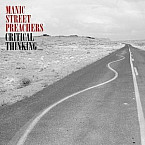

Critical Thinking

Album: Critical Thinking (2025)
Play Video

Songfacts®:

  • "Critical Thinking" is the title track from Manic Street Preachers' 15th studio album. The lyrics rail against corporate doublespeak and the kind of buzzwords that infest LinkedIn posts and well-meaning tote bags.

    This particular rant comes courtesy of Manic's bassist and lyricist Nicky Wire, who when interviewed by Mojo magazine, set his sights on one of modern life's more grating clichés. "The phrase 'Be your authentic self,'" he seethed. "I mean, what a calamitous f---ing idea! What do you think all the dictators and rapists are doing? They're being their authentic selves! My authentic self is gobs---e."
  • The song is a tense, stalking march with a heavy dose of post-punk paranoia: think Gang of Four, but with the added fury of a man who's just been forced to listen to a TED Talk on mindfulness. According to Wire, "Critical Thinking" is both a warning and a self-reprimand.

    "You have to go to the gym for the brain," he told NME. "Which for me was just writing it all down and trying to come to some different perspectives."
  • Frontman James Dean Bradfield, who sings most of the album, steps aside on this one, leaving Wire to deliver his message in his own unfiltered way. "Nick's trying to analyze his position in the world and reconcile his antagonism towards modern-day politics or beliefs," said Bradfield. "His song 'Critical Thinking' talks about empathy and the well-being industry, whilst we revel in other people's destruction."
  • Nicky Wire has spent the better part of his career sounding like a man who fell asleep reading a political manifesto and woke up to find himself in a rock band. Which, in fairness, is a pretty accurate summary of the Manic Street Preachers' entire ethos. Never ones for lyrical subtlety, the band has spent decades tackling everything from socialism to fascism to the slow, grinding disappointment of modern politics.

    Wire's songs often capture both fury and frustration - equal parts call to arms and weary sigh. Take "30 Year War," for example, a track that drips with contempt for British politics and historical betrayals, or "Golden Platitudes," which goes after Tony Blair's abandonment of Old Labour values. Then there's "All We Make Is Entertainment," a wry commentary on how culture has been hollowed out, commodified, and packaged into easily digestible mediocrity. And then, of course, there's "The Masses Against The Classes" - a song that, in true Manics fashion, borrows from Noam Chomsky and Albert Camus, because when Wire wants to make a point, he likes to bring backup.

    Given Wire's well-known interest in political discussion, it's no surprise that many of the Critical Thinking tracks are explicitly political. The left, he argues, is "really good at telling people off, which just makes everyone think: f--- off." Which, whether you agree with him or not, is a fairly concise summary of the 2020s.

Comments

Be the first to comment...

Editor's Picks

Joan Armatrading

Joan ArmatradingSongwriter Interviews

The revered singer-songwriter talks inspiration and explains why she put a mahout in "Drop the Pilot."
Carl Sturken

Carl SturkenSongwriter Interviews

Hitmaker Carl Sturken on writing and producing for Rihanna, 'N Sync, Christina Aguilera, Kelly Clarkson, Donny Osmond, Shakira and Karyn White.
Best Band Logos

Best Band LogosSong Writing

Queen, Phish and The Stones are among our picks for the best band logos. Here are their histories and a design analysis from an expert.

Linda Perry

Linda PerrySongwriter Interviews

Songwriting Hall of Famer Linda Perry talks about her songs "What's Up" and "Beautiful," her songwriting process, and her move into film music.
Chris Squire of Yes

Chris Squire of YesSongwriter Interviews

One of the most dynamic bass player/songwriters of his time, Chris is the only member of Yes who has been with the band since they formed in 1968.

Graham Bonnet (Alcatrazz, Rainbow)

Graham Bonnet (Alcatrazz, Rainbow)Songwriter Interviews

Yngwie Malmsteen and Steve Vai were two of Graham's co-writers for some '80s rock classics.