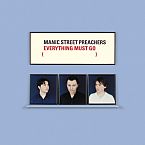

Everything Must Go

Album: Everything Must Go (1996)
Charted: 5
Play Video

Songfacts®:

  • The Manic Street Preachers' rhythm guitarist and chief lyricist, Richey James Edwards, disappeared on February 1, 1995, the day he was due to fly to the United States with James Dean Bradfield to promote their third album, The Holy Bible. He checked out of London's Embassy Hotel that morning and drove west. Two weeks later, his Vauxhall Cavalier was found abandoned near the Severn Bridge, a place long associated with disappearances. Investigators never found a confirmed trace of Edwards, despite one of the most extensive missing-person investigations in British music history. He was declared legally presumed dead in 2008.

    "Everything Must Go" is the title track of the Mamic's fourth album, their first record released as a trio, following the disappearance of Edwards.
  • The lyrics, written by bassist Nicky Wire, are directed to the band's fans. Lines such as "I just hope that you can forgive us" and "if you need an explanation then everything must go" read like both an apology and a declaration of intent. The Manics were moving away from the bleak, uncompromising intensity of The Holy Bible toward a broader, more melodic sound, while making it clear they hadn't forgotten where they had come from.
  • "Everything Must Go" was one of the last songs written for the album. Wire borrowed the title from a play his brother, writer Patrick Jones, was developing, realizing it captured the idea of clearing away the past in order to survive. "Once I had that title, it was a really easy lyric to write," he told Uncut magazine.

    Wire likened it to "You Love Us," which addressed the audience before they really had one, "whereas "Everything Must Go" was, you did love us, and we have to apologize, because we're going slightly off."
  • Producer Mike Hedges, who had previously worked with the likes of Siouxsie and the Banshees and the Beautiful South, oversaw the Everything Must Go sessions. His polished production perfectly matched the band's new sonic direction, which they first teased on the lead single. "A Design For Life."

    Sweeping string arrangements by Martin Greene gave the title track a cinematic scale, lifting their muscular rock into something grand without sacrificing its emotional weight. It proved that guitars and orchestras could coexist quite happily, much like tea and biscuits, provided nobody dunks for too long.
  • A remix by the Chemical Brothers reworked the track with their signature big‑beat electronics. Their version appeared on the soundtrack to the original Gran Turismo for PlayStation in 1998, introducing the Manics' post-Richey era to a generation of gamers who may have discovered the band while trying not to crash a Nissan Skyline into a tire barrier.
  • The music video, directed by W.I.Z. (Andrew Whiston), mirrors the song's themes of loss and renewal. Performance footage is interwoven with images of petals and blossom falling from trees, visual metaphors for beauty cut short and the absence left by Edwards.

    W.I.Z. would later reunite with the band for their video for "If You Tolerate This Your Children Will Be Next."
  • A separate promotional clip was also produced for the Chemical Brothers remix, combining footage from the band's video with gameplay and cinematic sequences from Gran Turismo. It helped solidify "Everything Must Go" as both a defining moment in the Manic Street Preachers' career and an unlikely fixture of late-'90s gaming culture.

Comments

Be the first to comment...

Editor's Picks

Yacht Rock!

Yacht Rock!Song Writing

A scholarly analysis of yacht rock favorites ("Steal Away," "Baker Street"...) with a member of the leading YR cover band.
John Lee Hooker

John Lee HookerSongwriter Interviews

Into the vaults for Bruce Pollock's 1984 conversation with the esteemed bluesman. Hooker talks about transforming a Tony Bennett classic and why you don't have to be sad and lonely to write the blues.
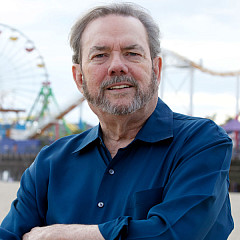
Jimmy Webb

Jimmy WebbSongwriter Interviews

Webb talks about his classic songs "By the Time I Get to Phoenix," "Wichita Lineman" and "MacArthur Park."
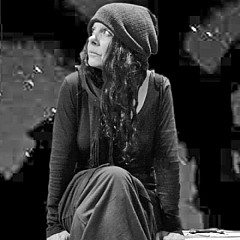
Johnette Napolitano of Concrete Blonde

Johnette Napolitano of Concrete BlondeSongwriter Interviews

The singer/bassist for Concrete Blonde talks about how her songs come from clairvoyance, and takes us through the making of their hit "Joey."
P.F. Sloan

P.F. SloanSongwriter Interviews

P.F. was a teenager writing hits and playing on tracks for Jan & Dean when he wrote a #1 hit that got him blackballed.
Which Songs are About Drugs?

Which Songs are About Drugs?Fact or Fiction

"25 or 6 to 4" to "Semi-Charmed Life" - see if you can spot the songs that are really about drugs.