
The Emperor Of Wyoming

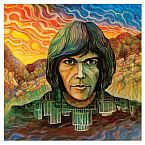
Album: Neil Young (1969)
Play Video

Songfacts®:

  • Being the opening track on Neil Young's self-titled solo debut album, "The Emperor of Wyoming" is in some ways the song that first introduced the general public to Neil Young as a solo artist (he'd already achieved a degree of notoriety with Buffalo Springfield).

    In his April 5, 1969 Rolling Stone review of the song, Gary Von Tersh described it as "an instrumental which sets the tone musically for the side in a high-flying yet whining sort of way. It has that definite Springfieldian touch to it like wind between rocks or the people you see in dreams."

    Von Tersh's poetic summation is fitting because, as with most Young songs, there's something ethereal slithering through the music. It's technically true that "The Emperor of Wyoming" is an instrumental that sounds vaguely like a song out of the Old West, but that doesn't explain the intangible qualities of Young's art.
  • If the real "Emperor of Wyoming" was ever named publicly, the statement's been lost to the sands of time. One intriguing theory, however, is that it is David Briggs, who was born in Douglas, Wyoming. Briggs picked up a hitchhiking Young in 1968, and the chance encounter led to Briggs producing Neil Young and several other Young albums. The two of them remained close friends for the remainder of Briggs' life (he died in 1995).
  • A widely regarded theory was that the song is about Stephen Stills, who played with Young in Buffalo Springfield and CSN&Y. The theory was so popular that Michael Watts titled a 1972 Melody Maker feature, "Stephen Stills: The Loner." The first two lines in the piece were lyrics from the song.

    In that interview, Stills suggests that Young wrote it about himself. Most fans agree with Stills, though Young has never made a definitive statement one way or the other. The song was written while Buffalo Springfield was still together but beginning to come apart.

    Stills did a version of the song on his album Illegal Stills in 1976.
  • This is the first Neil Young song produced by David Briggs, who proved a lifelong collaborator and friend, and who may also be the subject of "The Emperor Of Wyoming." Briggs said they put Young's guitar though a Leslie speaker to attain "psycho guitar noises."
  • Neil Young's reception was somewhat lukewarm, but "The Loner" stood out for critics and fans. A Rolling Stone review said, "'The Loner' is a contemporary lament that features a nice blending of Neil's guitar with strings in non-obtrusive fashion, allowing Young's balanced ice-pick vocal to chip effectively at the listener."

Comments

Be the first to comment...

Editor's Picks

Mike Scott of The Waterboys

Mike Scott of The WaterboysSongwriter Interviews

The stories behind "Whole Of The Moon" and "Red Army Blues," and why rock music has "outlived its era of innovation."
Tom Johnston from The Doobie Brothers

Tom Johnston from The Doobie BrothersSongwriter Interviews

The Doobies guitarist and lead singer, Tom wrote the classics "Listen To The Music," "Long Train Runnin'" and "China Grove."
Jon Anderson of Yes

Jon Anderson of YesSongwriter Interviews

From the lake in "Roundabout" to Sister Bluebird in "Starship Trooper," Jon Anderson talks about how nature and spirituality play into his lyrics for Yes.
Chris Frantz - "Genius of Love"

Chris Frantz - "Genius of Love"They're Playing My Song

Chris and his wife Tina were the rhythm section for Talking Heads when they formed The Tom Tom Club. "Genius of Love" was their blockbuster, but David Byrne only mentioned it once.
Experience Nirvana with Sub Pop Founder Bruce Pavitt

Experience Nirvana with Sub Pop Founder Bruce PavittSong Writing

The man who ran Nirvana's first label gets beyond the sensationalism (drugs, Courtney) to discuss their musical and cultural triumphs in the years before Nevermind.

Holly Knight ("The Best," "Love Is A Battlefield")

Holly Knight ("The Best," "Love Is A Battlefield")Songwriter Interviews

Holly Knight talks about some of the hit songs she wrote, including "The Warrior," "Never" and "The Best," and explains some songwriting philosophy, including how to think of a bridge.