All-American Bitch

Album: Guts (2023)
Charted: 13
Play Video

Songfacts®:

  • American writer Joan Didion's 1979 book The White Album is a compilation of autobiographical magazine articles. These essays, while loosely linked, delve into a range of themes encompassing the American Dream, celebrity culture, and the turbulent landscape of the late 1960s.

    One of these essays transports us to San Francisco, where Didion immerses herself in encounters with the counterculture, meeting hippies tripping on acid and attending Grateful Dead concerts. During her journey, she engages in a conversation with a young runaway hippie who refers to his mother as an "all-American bitch."

    Olivia Rodrigo told Phoebe Bridgers for Interview magazine that when she read The White Album, the phrase "all-American bitch" jumped out on her. She thought it the "coolest phrase" she'd ever heard and had to write a song about it.
  • The term "all-American" has its roots in the late 19th century United States. Initially, it was coined to describe a group of college football players renowned as the best in their respective positions. The inaugural "All-America" team, the 1889 College Football All-America Team, was handpicked by Caspar Whitney and published in a magazine called This Week's Sports in partnership with football pioneer Walter Camp.

    In her song "All-American Bitch," Rodrigo delves into the societal pressures and expectations imposed on women to align with the perceived ideal American standard. The emotions laid bare in the track underscore Rodrigo's sense of not quite fitting into American culture and society, leaving her feeling as though she falls short of embodying the perfect all-American woman.

    "It's one of my favorite songs I've ever written," Rodrigo told Apple Music. "I really love the lyrics of it and I think it expresses something that I've been trying to express since I was 15 years old - this repressed anger and feeling of confusion, or trying to be put into a box as a girl."
  • The song playfully celebrates the idea that society often expects young women to hide their discontent. "I've experienced a lot of emotional turmoil over having all these feelings of rage and dissatisfaction that I felt like I couldn't express, especially in my job," Rodrigo told The Guardian. "I've always felt like you can never admit it, be so grateful all the time, so many people want this position. And that causes a lot of repressed feelings. I've always struggled with wanting to be this perfect American girl and the reality of not feeling like that all the time."
  • Before the outro, Rodrigo unleashes an extended scream that's notable for her remarkably precise pitch control.

    I'm grateful all the time
    I'm sexy and I'm kind
    I'm pretty when I cry


    The controlled scream is a powerful way of conveying the feeling of being trapped and unable to express oneself fully. The scream is both a release of pent-up emotion and a reminder of the constraints that Rodrigo feels forced to conform to.

    The lines "I'm grateful all the time" and "I'm pretty when I cry" suggest that Rodrigo is constantly putting on a front, even when she is feeling angry or upset. The scream is a way of letting go of that façade, even if it is only for a moment.
  • "All-American Bitch" is the opening track on Olivia Rodrigo's second album, Guts. It kicks off with a breezy folk hymn vibe before making a sudden, electrifying shift into full-blown pop-punk chaos. Much like her previous album's opener, "Brutal," this song serves up a hefty dose of teenage angst and rock energy.
  • Olivia Rodrigo co-wrote "All-American Bitch" with her producer Dan Nigro. Rodrigo and Nigro worked together on every track on both Guts and Rodrigo's multi-platinum debut album, Sour.
  • I am light as a feather
    I'm as stiff as a board
    I pay attention to things that most people ignore


    At her October 9, 2023, concert at The Theater in LA's Ace Hotel, Rodrigo revealed her lifelong obsession with the "light as a feather, stiff as a board" concept. She fondly recalled her mom's stories of '80s sleepovers, where they'd attempt to lift each other with just one finger. Rodrigo dubbed it the "perfect way to encapsulate impossible standards as a girl and woman."
  • Rodrigo wrote "All-American Bitch" on the piano. When she sent it to Nigro as a last-minute addition for Guts, his first listen was a "holy s–t" moment. "[We had] super fun uptempo songs with super serious songs," he said. "I was confused as a producer, 'How do I bridge this together?' When she sent me ['All-American Bitch'] I was like, 'This is it - you just wrote the opening song for the record.'"
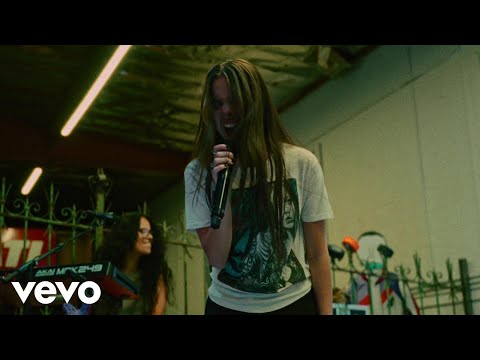
  • Olivia Rodrigo stirred things up with her performance of this song on the December 9, 2023, episode of Saturday Night Live. Rodrigo trashed the stage while chaotically rocking out on a fancy dinner table. Just as the song reached its climax, she stabbed a blood-red cake and smeared it over her face.

Comments

Be the first to comment...

Editor's Picks

David Bowie Lyrics Quiz

David Bowie Lyrics QuizMusic Quiz

How well do you know your David Bowie lyrics? Take this quiz to find out.

Rick Springfield

Rick SpringfieldSongwriter Interviews

Rick has a surprising dark side, a strong feminine side and, in a certain TV show, a naked backside. But he still hasn't found Jessie's Girl.

They Might Be Giants

They Might Be GiantsSongwriter Interviews

Who writes a song about a name they found in a phone book? That's just one of the everyday things these guys find to sing about. Anything in their field of vision or general scope of knowledge is fair game. If you cross paths with them, so are you.

Jon Foreman of Switchfoot

Jon Foreman of SwitchfootSongwriter Interviews

Switchfoot's frontman and main songwriter on what inspires the songs and how he got the freedom to say exactly what he means.

Daniel Lanois

Daniel LanoisSongwriter Interviews

Daniel Lanois on his album Heavy Sun, and the inside stories of songs he produced for U2, Peter Gabriel, and Bob Dylan.

Sam Phillips

Sam PhillipsSongwriter Interviews

Collaborating with T Bone Burnett, Leslie Phillips changed her name and left her Christian label behind - Robert Plant, who recorded one of her songs on Raising Sand, is a fan.