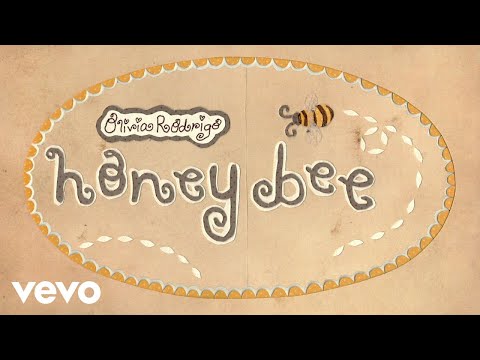
Honeybee

Album: You Seem Pretty Sad for a Girl So in Love (2026)
Charted: 9
Play Video

Songfacts®:

  • Though "Honeybee" is one of the most blissfully lovestruck songs on the album You Seem Pretty Sad for a Girl So in Love, it isn't quite the uncomplicated romance its warm melodies initially suggest. Beneath the sweetness runs a current of anxiety. Olivia Rodrigo isn't just celebrating love; she's grappling with the unnerving realization that having something wonderful means having something to lose.
  • Rodrigo compares her lover to a honeybee: a creature associated with sweetness, but also one that is difficult to hold onto and capable of inflicting sudden pain. A bee can drift away without warning. It can sting. And, it often dies after doing so. The metaphor allows Rodrigo to capture both the joy and fragility of deep attachment.

    That tension is distilled in the bridge:

    I hope I never see what your face looks like going
    A face I swear that I could spend my whole life knowing


    "Being with someone who you are attached to and adore in this way is the most terrifying thing ever," Rodrigo told Apple Music of the lyric.

    Rather than longing for something she'd already lost, she's confronting the anxiety of having something precious in the present and knowing it might not stay that way. That fear, she explained, was what made the emotion so powerful.
  • "Honeybee" was the first song written for You Seem Pretty Sad for a Girl So in Love. Rodrigo penned it in about 30 minutes at her piano at home, recalling an immediate wave of excitement about the track. It ultimately became one of only two songs on the record she wrote entirely by herself, alongside "Begged." She described the track as an attempt to write a more mature love song than she had tackled previously. While Rodrigo has never hidden her affection for youthful, straightforward romance, she wanted "Honeybee" to explore a more complicated emotional landscape. One where joy and apprehension occupy the exact same space.

    That idea became a guiding principle for the album as a whole. Speaking with Ryan Seacrest, Rodrigo explained that while researching her favorite love songs, she noticed that the ones that moved her most weren't purely happy. They carried traces of sadness, longing, melancholy, or fear. Those emotional shadows were what made them linger. Her goal was to create a love song that tugged at the heartstrings not despite its happiness, but because happiness felt fragile.
  • The track was produced by Daniel Nigro, Rodrigo's longtime collaborator. Rodrigo noted a charming detail about the recording: "One of my favorites on the album and the sneaky cricket that tried to ruin many vocal takes can be heard in the beginning of the song." That accidental ambient intruder gives the track a faintly bucolic, summery texture that suits its dreamy romanticism.
  • The honeybee has appeared in several songs over the years. Blake Shelton's 2011 hit "Honey Bee" uses the insect as a straightforward symbol of devotion and sweetness. Lucinda Williams' "Honey Bee" leans into desire and attraction, while The Kooks' song of the same name wraps infatuation in bright indie-pop. Rodrigo's contribution stands apart because she focuses on the vulnerability hidden inside happiness. She isn't simply enjoying the honey; she's already wondering how long it will last.
  • Rodrigo wrote "Honeybee," along with the rest of the album, about her relationship with the English actor Louis Partridge. The song's central fear ("I hope I never see what your face looks like going") resonates painfully in retrospect given that their relationship, reported to have begun in late 2023, ended in December 2025, well before the album's June 2026 release. The fact that "Honeybee" is the oldest song on the album suggests Rodrigo wrote it near the very beginning of that relationship, capturing a moment of pure, unguarded happiness before the doubts and insecurities documented on side 2 had yet to surface.

Comments

Be the first to comment...

Editor's Picks

Yoko Ono

Yoko OnoSongwriter Interviews

At 80 years old, Yoko has 10 #1 Dance hits. She discusses some of her songs and explains what inspired John Lennon's return to music in 1980.

Booker T. Jones

Booker T. JonesSongwriter Interviews

The Stax legend on how he cooked up "Green Onions," the first time he and Otis Redding saw hippies, and if he'll ever play a digital organ.

Gary Louris of The Jayhawks

Gary Louris of The JayhawksSongwriter Interviews

The Jayhawks' song "Big Star" has special meaning to Gary, who explains how longevity and inspiration have trumped adulation.

Ralph Casale  - Session Pro

Ralph Casale - Session ProSongwriter Interviews

A top New York studio musician, Ralph played guitar on many '60s hits, including "Lightnin' Strikes," "A Lover's Concerto" and "I Am A Rock."

Hawksley Workman

Hawksley WorkmanSongwriter Interviews

One of Canada's most popular and eclectic performers, Hawksley tells stories about his oldest songs, his plentiful side projects, and the ways that he keeps his songwriting fresh.

U2

U2Fact or Fiction

How did The Edge get his name? Did they name a song after a Tolkien book? And who is "Angel of Harlem" about?