Ja Nus Hons Pris

Album: not on an album (1192)
Play Video

Songfacts®:

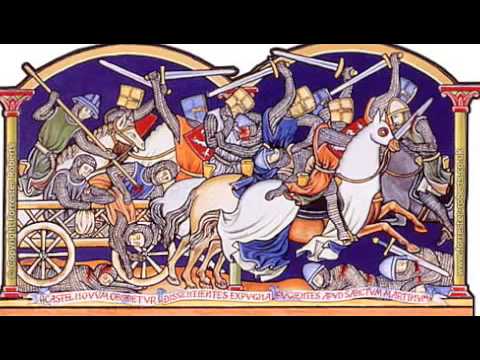
  • Also spelt "Ja Nuis Om Pres," this translates as "No Man Who Is Imprisoned." It has also been called "Song Of Captivity" and "King Richard's Ballad" It was written originally in French (i.e. the French language of the day) and the now endangered language Occitan by Richard The Lionheart, King of England.

    Richard ascended to the Throne in 1189. In 1192 while returning from his third crusade, he was captured and held prisoner by Leopold V, Duke of Austria, and held prisoner. He was handed over to Henry VI, Holy Roman Emperor, and while languishing in captivity, wrote this song as an address to Marie of France, Countess of Champagne, who was also his half-sister.

    "Ja Nus Hons Pris" has been recorded by Owain Phyfe (who played with Blackmore's Night) and by Bryan Ferry. >>
    Suggestion credit:
    Alexander Baron - London, England
  • Bryan Ferry covered this on his 2002 album Frantic, making this 35-second French medieval ballad one of the few songs recorded by a major recording star that was originally penned by an English king. (Though "Greensleeves" has long been attributed to Henry VIII, there is no historical proof that the much-married monarch actually composed the tune). The song is credited to one Richard Couer de Lion, (arrangement by Bryan Ferry and Colin Good.) Richard Coeur de Lion (Richard the Lion Heart) was the nickname of the French-speaking Richard I of England.
  • Richard I of England (1157-1199) was bought up at his French mother's court at Poitiers in Aquitaine, speaking French and Provencal. He was highly educated and trained in knightly chivalry and from an early age the prince was writing verse. As he grew older, Richard started writing ballads, which were poems telling a tale with a mandolin or similar instrument backing, written in medieval French.
  • Though most likely apocryphal, this musical tale is worth retelling:

    Shortly before Christmas 1192 Richard I was captured near Vienna by Leopold V, Duke of Austria, who accused the English monarch of arranging the murder of his cousin Conrad of Montferrat. Moreover, Richard had personally insulted Leopold by casting down his standard from the walls of Acre during the Third Crusade. Duke Leopold kept him prisoner at Dürnstein Castle.

    At first no one in England knew where their king was. A minstrel called Blondel searched for his master throughout Europe in vain. Returning home through Austria he learnt there was a closely guarded prisoner whose identity was a secret nearby. Suspecting it could be his master, he located a tiny barred window high up on the castle wall which he thought could be a cell. Under the window he sang the first couplet of a Troubadour's song which he had composed, a voice responded with the second couplet. It was the King.

    After being found by Blondel, Richard was handed over to Henry VI, Holy Roman Emperor. It was while languishing in captivity as the Holy Roman Emperor's prisoner that the monarch wrote this song as an address to Marie of France, Countess of Champagne. Eventually, the English people paid a huge ransom to set him free.

    (Source The Encyclopedia of Trivia.)

Comments

Be the first to comment...

Editor's Picks

Graham Nash

Graham NashSongwriter Interviews

Graham Nash tells the stories behind some of his famous songs and photos, and is asked about "yacht rock" for the first time.

Chad Channing (Nirvana, Before Cars)

Chad Channing (Nirvana, Before Cars)Songwriter Interviews

Chad tells tales from his time as drummer for Nirvana, and talks about his group Before Cars.

Experience Nirvana with Sub Pop Founder Bruce Pavitt

Experience Nirvana with Sub Pop Founder Bruce PavittSong Writing

The man who ran Nirvana's first label gets beyond the sensationalism (drugs, Courtney) to discuss their musical and cultural triumphs in the years before Nevermind.

Which Songs are About Drugs?

Which Songs are About Drugs?Fact or Fiction

"25 or 6 to 4" to "Semi-Charmed Life" - see if you can spot the songs that are really about drugs.

Chris Frantz of Talking Heads

Chris Frantz of Talking HeadsSongwriter Interviews

Talking Heads drummer Chris Frantz on where the term "new wave" originated, the story of "Naive Melody," and why they never recorded another cover song after "Take Me To The River."

70s Music Quiz 1

70s Music Quiz 1Music Quiz

The '70s gave us Muppets, disco and Van Halen, all which show up in this groovy quiz.