Stretchin' Out (In a Rubber Band)

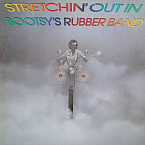
Album: Stretchin' Out in Bootsy's Rubber Band (1976)
Play Video

Songfacts®:

  • Bootsy Collins is an iconoclastic funk bass player. On this song, he's stretching out to spread his groove far and wide, bringing the party with him. The "rubber band" represents his elastic bass grooves. That same year (1976), The Spinners had a hit with "The Rubberband Man," which is more literal, telling the story of a guy who uses an actual rubber band as a bass.
  • Bootsy Collins was part of the P-Funk universe led by George Clinton; he joined the group in 1972 and became an integral part of their look and sound. In 1976 Clinton helped Bootsy step out with his own spin-off group, Bootsy's Rubber Band. "Stretchin' Out (In a Rubber Band)" was their first single and the first track on their debut album, Stretchin' Out in Bootsy's Rubber Band.

    Bootsy wrote and produced the song with George Clinton, and the singers and musicians were all part of P-Funk, including the singers Gary "Mudbone" Cooper and Robert "Peanut" Johnson. P-Funk horn players Rick Gardner (trumpet), Fred Wesley (trombone) and Maceo Parker (sax) appear as "The Horny Horns." The other musicians are:

    Garry Shider - guitar
    Michael Hampton - guitar
    Bernie Worrell - keyboards
  • On this song, Bootsy goes into character as Casper The Holy Ghost (not to be confused with Casper The Friendly Ghost). Like most of P-Funk, Bootsy has various alter-egos. One of his favorites is Bootzilla, the "rhinestone rock-star."
  • Bootsy gets some of his signature catch phrases into this one, including "Dig!" and "Glory be, the funk's on me!" He broke out the "Dig!" again in 1990 when he appeared on "Groove Is in the Heart" by Deee-Lite.
  • When Bootsy says he's "calling short distance," it means he's right there, so close he can whisper and you'll hear it. It's the opposite of calling long distance, which could involve hefty fees back in 1976.
  • When Bootsy says, "I'm gonna hit ya with the one," he's referring to the first beat of every measure, which James Brown called "the one." Bootsy was in Brown's band in 1970 and 1971, and Brown taught him to hit that note hard instead of waiting for the second or fourth beat, which was more common. This was a musical signature of the funk sound Brown and Collins helped create.

    "When James Brown said, 'Play it on the one,' I didn't know what that meant," Collins told Songfacts. "But I had sense enough to ask him, because I wanted to know what this 'one' was he kept talking about. And once he explained it, I said, 'Oh, I get it now,' but I didn't really get it. I had my version of it, and he started smiling when I started playing, so that was good enough for me. I figured I had "the one" then."

Comments

Be the first to comment...

Editor's Picks

Kristian Bush of Sugarland

Kristian Bush of SugarlandSongwriter Interviews

Kristian talks songwriting technique, like how the chorus should redefine the story, and how to write a song backwards.

Ben Kowalewicz of Billy Talent

Ben Kowalewicz of Billy TalentSongwriter Interviews

The frontman for one of Canada's most well-known punk rock bands talks about his Eddie Vedder encounter, Billy Talent's new album, and the importance of rock and roll.

Commercials

CommercialsFact or Fiction

Was "Ring Of Fire" really used to sell hemorrhoid cream?

Name the Character in the Song

Name the Character in the SongMusic Quiz

With a few clues (Works at a diner, dreams of running away), can you name the character in the song?

Richie Wise (Kiss producer, Dust)

Richie Wise (Kiss producer, Dust)Songwriter Interviews

Richie talks about producing the first two Kiss albums, recording "Brother Louie," and the newfound appreciation of his rock band, Dust.

Goodbye, Hello: Ten Farewell Tour Fake-Outs

Goodbye, Hello: Ten Farewell Tour Fake-OutsSong Writing

The 10 biggest "retirement tours" that didn't take.