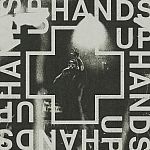
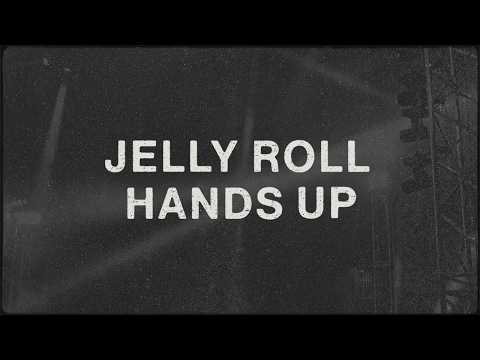
Hands Up

Album: released as a single (2026)
Play Video

Songfacts®:

  • "Hands Up" is Jelly Roll's autobiographical anthem about redemption, tracing his life through three defining moments when his hands went into the air, for very different reasons. The first is the exhilaration of discovering music, the second the humiliation of being arrested, and the third the surrender of embracing faith. Together they chart the unlikely route from troubled teenager to one of country music's most compelling voices. It's a reminder that the same gesture can mean celebration, defeat or worship, depending on who's asking you to raise your hands.
  • Like much of Jelly Roll's catalog, "Hands Up" is built on redemption rather than perfection. It occupies the same emotional territory as "Save Me" and "Son Of A Sinner," acknowledging failure without letting it have the final word.
  • Each verse captures a different chapter of Jelly Roll's story. The opening verse returns to Nashville Municipal Auditorium in December 1999, where, as a teenager, he saw Rage Against the Machine perform "Killing In The Name" and "Bulls On Parade." He describes the concert as "church for me" and "the first time I was born again," recalling the moment he realized music could give voice to kids who felt lost and angry.

    The second verse jumps to one of his lowest points. After breaking into a house to retrieve a bag of marijuana, Jelly Roll found himself cornered against a fence in a dead-end neighborhood, with a police officer ordering him to put his hands up. The incident reflects the arrests and jail sentences that punctuated his youth, experiences Jelly Roll has never tried to erase from his story, instead presenting them as evidence that grace often begins in places we'd rather not revisit.

    The final verse brings Jelly Roll to faith. He recalls finding "that little cross" in "that ol' sinner's row," where the voice urging him toward destruction finally gives way to the One calling him to surrender. This time, raising his hands is an act of worship, completing the song's journey from chaos to hope.
  • Jelly Roll wrote the song with Hardy, Chase McGill, Joe Fox and Rocky Block.

    Hardy is a Nashville artist‑writer who's become one of the core architects of modern country's rowdy‑but‑introspective sound, with hits for Morgan Wallen, Blake Shelton, and his own rock‑leaning records.

    Chase McGill is a Nashville songwriter known for sharp, story‑driven lyrics, with cuts for artists like Kane Brown ("Lose It"), Jordan Davis ("Next Thing You Know") and Morgan Wallen ("I Got Better").

    Joe Fox is a behind‑the‑scenes writer and vocal producer who has quietly built a résumé that includes Joe Pardi's "Last Night Lonely," Dylan Marlowe's "Boys Back Home" and Jelly Roll's deeply confessional track "My Cross."

    Rocky Block is one of Morgan Wallen's key songwriting partners. His Wallen credits include "Cowgirls," "Lies Lies Lies" and "I'm The Problem."
  • Produced by Charlie Handsome and Ben Johnson, the track blends Jelly Roll's hip-hop phrasing with a soaring country arrangement built around live drums, pedal steel and gospel-style backing vocals. The result feels equally at home in an arena concert or a Sunday morning service.
  • Jelly Roll released "Hands Up" on June 24, 2026, during a difficult season in his personal life. Only weeks earlier, he had filed for divorce from Bunnie Xo after nearly a decade of marriage. Rather than addressing the split directly, the song doubles down on the themes that have always resonated most strongly with his audience: faith, forgiveness, perseverance and the conviction that no past is beyond redemption.

Comments

Be the first to comment...

Editor's Picks

Yoko Ono

Yoko OnoSongwriter Interviews

At 80 years old, Yoko has 10 #1 Dance hits. She discusses some of her songs and explains what inspired John Lennon's return to music in 1980.

Booker T. Jones

Booker T. JonesSongwriter Interviews

The Stax legend on how he cooked up "Green Onions," the first time he and Otis Redding saw hippies, and if he'll ever play a digital organ.

Gary Louris of The Jayhawks

Gary Louris of The JayhawksSongwriter Interviews

The Jayhawks' song "Big Star" has special meaning to Gary, who explains how longevity and inspiration have trumped adulation.

Ralph Casale  - Session Pro

Ralph Casale - Session ProSongwriter Interviews

A top New York studio musician, Ralph played guitar on many '60s hits, including "Lightnin' Strikes," "A Lover's Concerto" and "I Am A Rock."

Hawksley Workman

Hawksley WorkmanSongwriter Interviews

One of Canada's most popular and eclectic performers, Hawksley tells stories about his oldest songs, his plentiful side projects, and the ways that he keeps his songwriting fresh.

U2

U2Fact or Fiction

How did The Edge get his name? Did they name a song after a Tolkien book? And who is "Angel of Harlem" about?