The Lark Ascending

Album: Vaughan-Williams: The Lark Ascending & Violin Concerto (1920)
Play Video

Songfacts®:

  • Ralph Vaughan Williams was born on October 12, 1872, in Down Ampney, Gloucestershire, England, the son of a clergyman. He was educated at the Royal College of Music and Trinity College in Cambridge University, after which he became organist of St. Barnabas' Church in London.

    Vaughan Williams developed a national style of music deriving from English choral tradition, especially of the Tudor period, and folksong. In 1910 he completed his first significant composition, the "Fantasia on a Theme by Thomas Tallis" for strings.

    After serving in World War I, Vaughan Williams was appointed the Professor of Composition at the Royal College of Music and conductor of London's Bach Choir. He continued to compose until his death in London on August. 26, 1958

    As well as nine symphonies, Vaughan Williams also composed the ballet Job (1930), the opera The Pilgrim's Progress (1948-9), and numerous choral works, songs, and hymns, including an adaptation of "To Be A Pilgrim." He also wrote for films, such as Scott of the Antarctic (1948).
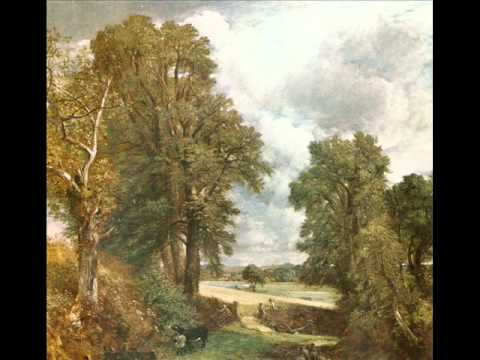
  • Vaughan Williams started working on The Lark during the summer of 1914. He was inspired by George Meredith's 122-line poem of the same name about the skylark. He composed it for violin and piano in the early weeks of the Great War and is said to have imagined the world of his youth disappearing with the lark into the cloudless sky.
  • The war halted Vaughan Williams' composing, during which he served as an ambulance driver. He re-scored The Lark for solo violin and orchestra in 1920 with the help of the English violinist Marie Hall. The soaring and fluttering of the violin represent the song of the lark.
  • The piano and violin version was premiered on December 15, 1920, in conjunction with the Avonmouth and Shirehampton Choral Society at Shirehampton Public Hall. The first orchestral performance followed half a year later on June 14, 1921, with the British Symphony Orchestra under conductor Adrian Boult.
  • The Lark is one of the most popular pieces in the Classical repertoire among British listeners. In a 2011 poll of listeners to choose the nation's Desert Island Discs, it was chosen as Britain's all-time favorite. The work has also been voted #1 in the Classic FM annual Hall of Fame poll on several occasions.

Comments

Be the first to comment...

Editor's Picks

Annie Haslam of Renaissance

Annie Haslam of RenaissanceSongwriter Interviews

The 5-octave voice of the classical rock band Renaissance, Annie is big on creative expression. In this talk, she covers Roy Wood, the history of the band, and where all the money went in the '70s.

Jason Newsted (ex-Metallica)

Jason Newsted (ex-Metallica)Songwriter Interviews

The former Metallica bassist talks about his first time writing a song with James Hetfield, and how a hand-me-down iPad has changed his songwriting.

Gary Louris of The Jayhawks

Gary Louris of The JayhawksSongwriter Interviews

The Jayhawks' song "Big Star" has special meaning to Gary, who explains how longevity and inspiration have trumped adulation.

Rufus Wainwright

Rufus WainwrightSongwriter Interviews

Rufus Wainwright on "Hallelujah," his album Unfollow The Rules, and getting into his "lyric trance" on 12-hour walks.

Classic Metal

Classic MetalFact or Fiction

Ozzy, Guns N' Roses, Judas Priest and even Michael Bolton show up in this Classic Metal quiz.

Chris Rea

Chris ReaSongwriter Interviews

It took him seven years to recover from his American hit "Fool (If You Think It's Over)," but Chris Rea became one of the top singer-songwriters in his native UK.